Chemistry - Online Test
Q1. The correct IUPAC name of [Fe(C5H5)2] is
Answer : Option C
Explaination / Solution:
C5H5 is cyclopentadienyl ligand. Name of ligand is written first.
Q2. Emf of the cell

at 298 K is
at 298 K is
Answer : Option D
Explaination / Solution:

Q3. The tetrahedral molecule below where there are two lone pairs of electrons is
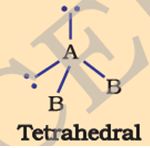
Answer : Option B
Explaination / Solution:
An important feature of water is its polar nature. The structure has a bent molecular geometry for the two hydrogens from the oxygen vertex. The oxygen atom also has two lone pairs of electrons.
Q4. Hydrocarbons having double the number of carbon atoms than present in the original alkyl halide are produced by using
Answer : Option B
Explaination / Solution:
The Wurtz reaction, named after Charles-AdolpheWurtz, is a coupling reaction in organic chemistry, organometallic chemistry and recently inorganic main group polymers, whereby two alkyl halides arereacted with sodium metal in dry ethereal solution to form a higher alkane:
Q5. Alkali metal chlorides donot form hydrates except for one metal. Choose from among the options given below.
Answer : Option B
Explaination / Solution:
Lithium due to its high hydration energy(deliquescent) forms hydrate.
Q6. During hearing of a court case, the judge suspected that some changes in the documents had been carried out. He asked the forensic department to check the ink used at two different places. According to you which technique can give the best results?
Answer : Option A
Explaination / Solution:
TLC will give the best results.
Q7. If a reaction proceeds with a uniform rate throughout, the reaction is
Answer : Option B
Explaination / Solution:
Rate of reaction is independent of concentration of reactant.
Q8. Which among the following is an example of homogenous catalyst?
Answer : Option A
Explaination / Solution:
Homogeneous catalysis is one in which catalyst and reactants are both in same phase.
Q9.
At, the density of a certain oxide of a gas at 2 bar is same as that of dinitrogen at 5 bar. What is the molecular mass of the oxide?
Answer : Option C
Explaination / Solution:
PV=(m/M)RT
Q10. Hydrolysis of protein into peptone is brought about by.
Answer : Option C
Explaination / Solution:
Pepsin enzyme leads hydrolysis of proteins.