Chemistry - Online Test
Q1.
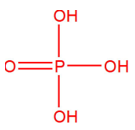 is the structure of
is the structure of
Answer : Option D
Explaination / Solution:
This structure is of H3PO4 . (Orthophosphoric acid). It has three P-OH and one P=O bonds.
Q2. Standard Molar Enthalpy of Formation is
Answer : Option B
Explaination / Solution:
The standard enthalpy change for the formation of one mole of a compound from its elements in their most stable states of aggregation is enthalpy of formation.
Q3. The impurity that is added externally to remove the impurity already present in the ore is known as
Answer : Option D
Explaination / Solution:
Flux combines with impurities to form Slag which is easily separable.
Q4. The third period (n = 3) begins at sodium with addition of first electron to
Answer : Option B
Explaination / Solution:
The electronic configuration of sodium is 1s2 2s2 2p6 3s1. The valence electron is in 3s orbital.
Q5.
Mg2+ is isoelectronic with
Answer : Option D
Explaination / Solution:
Isoelectronic species refers to the elements that have the same number of electrons.
Mg2+ is a 10 electron species .Its configuration is like that of Ne.
Thus it is isoelectronic with any element having 10e- or we can say 8e- in its valence shell.
Atomic number of Sodium (Na) is 11 after loosing one electron it became Na+ and have 10 electron.
Thus Mg2+ is isoelectronic with Na+.
Q6. A given compound always contains exactly the same proportion of elements by weight. This law is stated by
Answer : Option D
Explaination / Solution:
The observation was first made by French chemist Joseph Proust , based on certain experiments conducted between 1798 and 1804.
Proust made the above statement known as " Proust's law " or " Law of definite composition " or " Law of constant composition "
Q7. Inadequate pollution control equipments result in the :
Answer : Option C
Explaination / Solution:
Inadequate pollution control equipments release greater amount of carbon monoxide that increases the pollution even further.
Q8. Which of the following sublimes on heating?
Answer : Option A
Explaination / Solution:
HgCl2 sublimes on heating.
Q9. Benzene gets converted to benzaldehyde by Gatterman – Koch reaction. The appropriate reagent for the conversion is
Answer : Option B
Explaination / Solution:

Q10. The ionic hydrides are crystalline, non-volatile but on melting does one of the following:
Answer : Option C
Explaination / Solution:
They are formed when hydrogen molecule reacts with most s-block elements which are highly electropositive in nature. In solid state, the ionic hydrides are crystalline, non-conducting and non-volatile.
However, in liquid state it conducts electricity. Ionic hydrides on electrolysis liberate hydrogen gas at the anode.