Chemistry - Online Test

Q1. Benzene diazonium chloride reacts with phenol in which the phenol molecule at its para position is coupled with the diazonium salt to form p – hydroxyazobenzene
Answer : Option D
Explaination / Solution:

This normal N-N coupling.

Q2.

For the reaction

 Which is the limiting reagent for this reaction ?


Answer : Option B
Explaination / Solution:

Chemical reactions rarely  occur completely when exactly the right amounts of reactants are taken to react together  to yield products as per its stoichiometry .One of the  reactants  will be used up  ,before another runs out.Thus , the reactant which  is consumed first is known as limiting reagent 

For  the given reaction ,

2 N2 H(l)      +     N2 O4  (l)  ------>   3 N2 (g)     +  4 H2 O (l)

as per its stoichiometry , if  only the right and exact amount of  NO4 is taken , the reaction may not go to completion .As such it would be consumed first & is , therefore , the  limiting reagent. 


Q3.  is dissolved in water to give 500 mL of solution. The pH of the solution is
Answer : Option C
Explaination / Solution:

pOH=-log[] and here [OH-] = (0.3 x 1000)/(74 x500) While pH=14-pOH

Q4. One mole of a symmetrical alkene on ozonolysis, and subsequent treatment with ( Zn / H2 O ) gives two moles of an aldehyde having a molecular mass of 44 u. The alkene is ---------.?
Answer : Option D
Explaination / Solution:

Ozonolysis of alkenes involves the addition of ozone molecule to alkene to form an unstable ozonide , and then cleavage of the ozonide by  to smaller molecules .  

2- butene is a symmetrical alkene , which on ozonolysis yields two moles of   having molecular mass   of 44 u. as per reaction given   below,
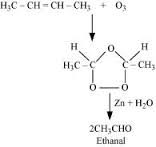


Q5. Which among the following is a method of concentration of ore?
Answer : Option C
Explaination / Solution:

Leaching is method of concentration of ore. In which ore is digested with particular solvent to form a soluble complex.

Q6. Ammonia is used in detection of
Answer : Option D
Explaination / Solution:

Copper ions react with NH3 to form a blue color complex.

Q7. Which crystal system has axial angles equal to ?
Answer : Option C
Explaination / Solution:

Orthorhombic crystal system has axial angles 
Q8. Nylon – 2 – Nylon – 6 is
Answer : Option B
Explaination / Solution:

Nylon -2-nylon-6 is polyamide copolymer.

Q9. The typical range of molar enthalpies for the strongest intermolecular (Hydrogen) bonds is
Answer : Option C
Explaination / Solution:

A hydrogen bond is the electrostatic attraction between two polar groups that occurs when a hydrogen (H) atom linked to a small sized highly electronegative atom such as nitrogen (N), oxygen (O), or fluorine (F). Therefore unlike a covalent bond, it has very low dissociation energy with a range of molar enthalpy = ( 4 − 25 ) kJ

Q10. Deforestation is responsible for:
Answer : Option B
Explaination / Solution:

Deforestation is responsible for desertification