Chemistry - Online Test
Q1. first law of thermodynamics is a restatement of
Answer : Option A
Explaination / Solution:
t is restatement of law of conservation of energy.
It states that Thermodynamics isthe branch of physical science that deals with the relations between heat and other forms of energy (such as mechanical, electrical, or chemical energy), and, by extension, of the relationships between all forms of energy.
Q2. Which is the most abundant metal on earth?
Answer : Option B
Explaination / Solution:
Aluminium is most abundant.
Q3. Charge on the electron was determined by
Answer : Option C
Explaination / Solution:
In 1909, Robert Millikan and Harvey Fletcher conducted the oil drop experiment to determine the charge of an electron. They suspended tiny charged droplets of oil between two metal electrodes by balancing downward gravitational force with upward drag and electric forces.
The experiment helped earn Millikan a Nobel prize in 1923
Q4. Which of the following pollutants can degrade by natural processes :
Answer : Option A
Explaination / Solution:
Vegetables have cell walls made up of cellulose which is a natural polymer and thus is bio-degradable, so they breakdown by natural processes.
Q5. Which among the following is the coinage metal?
Answer : Option A
Explaination / Solution:
Cu , Ag ,Au are known as coinage metals.
Q6. Give IUPAC names of the following compound:
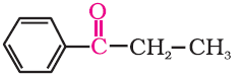
Answer : Option B
Explaination / Solution:
This is 1-phenyl propan-1-one.
Q7. A group of atoms can function as a ligand only when
Answer : Option D
Explaination / Solution:
Ligands are electron donors.
Q8. Hydrogen has three isotopes: protium, deuterium, and tritium. Which of them is radioactive and emits beta particles ?
Answer : Option A
Explaination / Solution:
Due to unfavourable neutron to proton ratio, tritium emits low energy beta particles.
Q9. Penicillin Fungus was discovered by
Answer : Option D
Explaination / Solution:
Penicillin Fungus was discovered by Alexander Flemming.
Q10. Fundamental difference between an electrolytic cell and the galvanic cell is that in an electrolytic cell free energy
Answer : Option C
Explaination / Solution:
In electrolytic cell electrical energy is converted into chemical energy.