Chemistry - Online Test
Q1. Catalyst used in hydrogenation of vegetable oil is
Answer : Option A
Explaination / Solution:
Vegetable oil is unsaturated fats which are hydrogenated used Ni as catalyst.
Q2. The following amine is called as
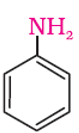
Answer : Option D
Explaination / Solution:
The above compound is aniline and benzeneamine.
Q3. In the dynamic equilibrium stage, one of the following events take place. Choose the right one.
Answer : Option C
Explaination / Solution:
there is no change in the conc of reactant and product. At dynamic equilibrium, reactants are converted to products and products are converted to reactants at an equal and constant rate. Reactions do not necessarily—and most often do not—end up with equal concentrations. Equilibrium is the state of equal, opposite rates, not equal concentrations.
Q4. Which are three important states of matter ?
Answer : Option A
Explaination / Solution:
Three phases of matter are :
1. Solid - firm and stable in shape; not liquid or fluid, strongest intermolecular forces.
2. Liquid - A liquid is a nearly incompressible fluid that conforms to the shape of its container but retains a (nearly) constant volume independent of pressure. Intermediate molecular forces.
3. Gas -Takes the volume of the container, weakest intermolecular forces.
Q5. Isopropyl alcohol on oxidation forms:
Answer : Option B
Explaination / Solution:
Secondary alcohols are oxidized to ketones. The oxidation of isopropyl alcohol by potassium dichromate (K2Cr2O7) gives acetone, the simplest ketone: Unlike aldehydes, ketones are relatively resistant to further oxidation, so no special precautions are required to isolate them as they form.
Q6. Saturated Hydrocarbons contain
Answer : Option C
Explaination / Solution:
saturated hydrocarbons are the compounds in which there is a single bond between the carbon atoms.They are also called alkanes and have the general formula CnH2n+2
Q7. Molality of a solution relates the
Answer : Option B
Explaination / Solution:
Molality is number of moles of solute dissolved in per Kg of solvent.
Q8. Amorphous solids are also known as
Answer : Option C
Explaination / Solution:
Because they show property of flowing like liquids
Q9. Mendeleev arranged elements in a periodic table in order of their increasing atomic weights in such a way that the elements with similar properties occupies
Answer : Option C
Explaination / Solution:
Mendeleev arranged elements in horizontal rows and vertical columns of a table in order of their increasing atomic weights in such a way that the elements with similar properties occupied the same vertical column or group.This is because properties of elements are reapting after regular interval.
Q10. Cellulose, starch, resins and rubber belong to one of the following category of polymers
Answer : Option D
Explaination / Solution:
They all are natural polymers.