Chemistry - Online Test
Q1. The narcotic analgesic administered in medicinal doses is
Answer : Option C
Explaination / Solution:
Morphine is the narcotic analgesic admininstered in medical doses.
Q2. Galvanic or a voltaic cell converts the chemical energy liberated during a redox reaction to
Answer : Option D
Explaination / Solution:
Galvanic cells convert chemical energy to electrical energy.
Q3. Matter can be classified at the macroscopic or bulk level as
Answer : Option C
Explaination / Solution:
At macroscopic level matter is classified as mixture or pure substances
.A mixture contains two or more components (in any ratio ) present in it , for example -- sugar solutions in water , tea , air , alloys like brass ,bronze etc.
Pure substances (viz. copper , silver , gold , water , glucose etc . ) have fixed composition .
The constituents of pure substances can not be separated by simple physical methods.
Q4. Inertness of noble gas was observed to be due to their electronic configurations: Choose the most appropriate
Answer : Option B
Explaination / Solution:
The six noble gases (Helium Neon Argon Krypton Xenon Radon) are found in group 18 of the periodic table. These elements were considered to be inert gases until the 1960's, because their oxidation number of 0 prevents the noble gases from forming compounds readily. All noble gases have the maximum number of electrons possible in their outer shell (2 for Helium, 8 for all others), making them stable.
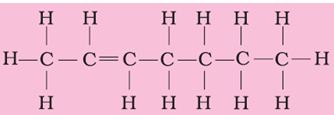
Q5. Condense the following complete structural formula given below. Choose the appropriate answer given below
Answer : Option B
Explaination / Solution:
All the single bonds are broken and atoms are written together.
Q6. The term reduction has one of the following options taking place.
Answer : Option D
Explaination / Solution:
Reduction is addition of hydrogen, removal of oxygen, removal of an electronegative element or addition of an electropositive element.
- Removal of Oxygen: Reduction is a chemical reaction in which oxygen is removed from any chemical species (atom, ion or molecule).
CuO + C → Cu + CO
H2O + C → CO + H2
2CO + O2 → 2CO2
Fe3O4 + 4H2 → 3F2 + 4H2O - Addition of Hydrogen : Reduction is a chemical reaction in which hydrogen is added to any chemical species (atom, ion or molecule).
Cl2 + H2 → 2HCl
S + H2 → H2S
C2H4 + H2 → C2H6 - Removal of an Electronegative Element: Reduction is a chemical reaction in which an electronegative element is removed from any chemical species (atom, ion or molecule).
2HgCl2 + SnCl2 → Hg2Cl2 + SnCl4 (Reduction of mercuric chloride)
2FeCl3 + H2 → 2FeCl2 + 2HCl (Reduction of ferric chloride)
2FeCl3 + H2S → 2FeCl2 + 2HCl + S (Reduction of ferric chloride)
- Addition of an Electropositive Element: Reduction is a chemical reaction in which an electropositive element is added any chemical species (atom, ion or molecule).
HgCl2 + Hg → Hg2Cl2 (Reduction of mercuric chloride)
CuCl2 + Cu → Cu2Cl2 (Reduction of cupric chloride) - The substance which brings reduction is known as reducing agent.
- A substance, which undergoes oxidation, acts as a reducing agent while a substance, which undergoes reduction, acts as an oxidizing agent.
Mg, S, Cu, Na2SO3, H2S, HI, H2, C, KI are reducing agents, while O2, Cl2, F2, H2O2, MnO2, FeCl3, CuCl2, Fe3O4, CuO, etc., are oxidizing agents in the above examples.
- All oxidation and reduction reactions are complimentary of one another and occur simultaneously, one cannot take place without the other.
- No single oxidation and no single reduction process is known. The simultaneously oxidation and reduction reactions are generally termed as redox reactions. e.g., 2FeCl3 + SnCl2 → 2FeCl2 + SnCl4.
In above example iron undergoes reduction from +3 to +2.
Q7. Group I elements of the periodic table are collectively known as
Answer : Option D
Explaination / Solution:
Group I ( )elemens react vigorously with water to produce an alkaline solution thus colectively known as alkali metals
Q8. Give IUPAC names of the following compound:

Answer : Option C
Explaination / Solution:
Chloro is given priority so umbered as 1
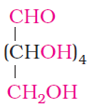
Q9. The following molecule is called as
Answer : Option B
Explaination / Solution:
It is aldohexose. An aldohexose is a hexose with an aldehyde group on one end.it is naturally occurring in nature and is found in fruits.
Q10. Which among the following is an instantaneous reaction?
Answer : Option D
Explaination / Solution:
Precipitation of AgCl is an example of instantaneous reaction.