Chemistry - Online Test

Q1. The average molecular mass of colloidal can be determined by
Answer : Option B
Explaination / Solution:

Average molecular mass of colloidal solution is determined by Osmotic Pressure measurement.

Q2. Calculate the temperature of 4.0 mol of a gas occupying 5 at 3.32 bar. (R = 0.083 bar ).
Answer : Option A
Explaination / Solution:

wehavePV=nRTorT=PVnR=3.22bar×5dm34mol×0.083bardm3K1mol1=50K
Q3. ATP is
Answer : Option B
Explaination / Solution:

ATP is nucleotide.

Q4. Alkenes react with water in the presence of acid as catalyst to form alcohols.
Answer : Option A
Explaination / Solution:

The addition of water to an alkene in the presence of a catalytic amount of strong acid leads to the formation of alcohols (hydroxy‐alkanes).
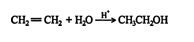
This reaction proceeds via a standard carbocation mechanism and follows the Markovnikov rule.

The mechanism for the addition of water to ethene follows.

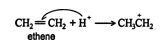
1. The hydrogen ion is attracted to the π bond, which breaks to form a σ bond with one of the double‐ bonded carbons. The second carbon of the original double‐bonded carbons becomes a carbocation.
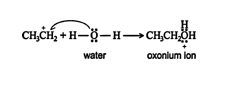
2.An acid‐base reaction occurs between the water molecule and the carbocation, forming an oxonium ion.
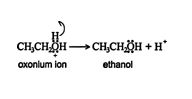
3. The oxonium ion stabilizes by losing a hydrogen ion, with the resulting formation of an alcohol.

Q5. Which of the following options will be correct for the stage of half completion of the reaction A ⇌B.
Answer : Option C
Explaination / Solution:

Equilibrium will be established so  = 0

Q6. Camphor is often used in molecular mass determination because
Answer : Option D
Explaination / Solution:

Camphor has very high cryoscopic constant.

Q7. Chlorine, bromine and iodine when combined with oxygen, have oxidation numbers
Answer : Option D
Explaination / Solution:

This is according to the rules of assigning oxidation number i.e. Chlorine, Bromine, Iodine have positive oxidation numbers when combined with oxygen, for example in oxoacids and oxoanions.

Q8. Which of the following is a tertiary amine?
Answer : Option D
Explaination / Solution:

this is tertiary amine.

Q9. There are ____ L in 0.05 ml?
Answer : Option C
Explaination / Solution:

Since ,  1L

= 1000mL  

   or , 1mL

 = .

  0.05mL

=    

=  0.00005 L .


Q10. Ethyl benzene CANNOT be prepared by ______
Answer : Option C
Explaination / Solution:

Wurtz reaction is used to prepare alkanes with even number of carbon atoms.To prepare ethylbenzene,Wurtz Fittig reaction has to be used.