General Science - Online Test
Q1. First International Conference on environment held on;
Answer : Option D
Explaination / Solution:
No Explaination.
Q2.
In the following figure a synapse is shown :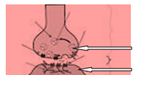
i & ii (from up to down)
1) (i) is presynaptic membrane and (ii) is postsynaptic membrane.
2) synaptic vesicles are in postsynaptic knob.
3) neurotransmitter receptors are located on postsynaptic membrane.
Answer : Option C
Explaination / Solution:
The synapse is formed by the membranes of apre-synaptic neuron and a post-synaptic neuron, which may or may notbe separated by a gap called synaptic cleft. The neurotransmitter receptors are located on postsynaptic membrane.
Q3. If the substance is in the form of a long rod, then for small change in temperature, ΔT, the fractional change in length, Δl/l, is
Answer : Option C
Explaination / Solution:
α=Δll×ΔTΔll=aΔT
Q4. The general shape of TPP in the short run is
Answer : Option B
Explaination / Solution:
No Explaination.
Q5. Acid rain is :
Answer : Option A
Explaination / Solution:
The acidic gaseous pollutants like oxides of sulphur and nitrogen react with water and come down to earth in form of acid rain.
Q6. Which is the most stable oxidation state of iron?
Q7. Who was a great biometrician and statistician?
Answer : Option C
Explaination / Solution:
Karl Pearson was an influential biometrition and statistician who has been credited with establishing the discipline of mathematical statistics.
Q8. In India per capita income is about ___ dollar per annum
Answer : Option C
Explaination / Solution:
Per capita income or average income measures the average income earned perperson in a given area (city, region, country, etc.) in a specified year. It is calculated by dividing the area's total income by its total population.
Q9. Which classes of algae possess chlorophyll a, chlorophyll b, carotenoids and xanthophylls?
Answer : Option B
Explaination / Solution:
Phaeophyceae possess chlorophyll a, c, carotenoids and xanthophylls. They vary in colour from olive green to various shades of brown depending upon the amount of the xanthophyll pigment, fucoxanthin present in them.
Q10. Each centriole is surrounded by dense amorphous protoplasmic masses called
Answer : Option B
Explaination / Solution:
All animal cell have two small organelles called centrioles. Each centriole is surrounded by dense amorphous protoplasmic masses called Massules.