General Science - Online Test

Q1. The complete combustion of glucose produces
Answer : Option C
Explaination / Solution:

The complete combustion of glucose, which produces carbon dioxide and water as end products, yields energy most of which is given out as heat.

Q2. One of the following is highly radioactive
Answer : Option A
Explaination / Solution:

Fr is highly radioactive metal, that decays in to astatine,,radium and radon , it is also highly unstable element found only in trace amount on earth.

Q3. Which of the followings is also called sac fungi that live parasitically and in various habitats?
Answer : Option A
Explaination / Solution:

Ascomycetes is called as sac fungi that live parasitically and in various habitats. They are responsible for a number of fungal disease in plants.

Q4. In general, in the molecules containing multiple bonds,_____ provide the most reactive centres. Choose the most appropriate one.
Answer : Option A
Explaination / Solution:

pie bonds are the most reactive centers.

Q5. According to Farady's law for a coil having N turns, the total induced emf is given by
Answer : Option C
Explaination / Solution:

The induced electromotive force in any closed circuit is equal to the negative of the time rate of change of the magnetic flux enclosed by the circuit.

induced emf for a coil having 1 turns will be 

The flux of all the turns will be added up. So the induced emf for a coil having N turns will be 
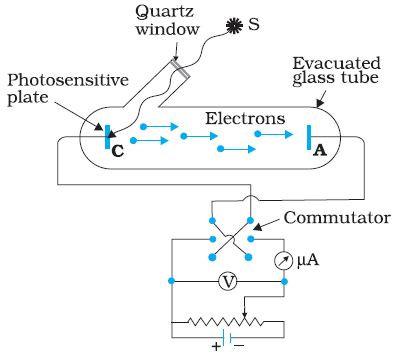

Q6. Stopping potential in the experimental set up shown in figure is 

Answer : Option A
Explaination / Solution:

The negative potential of the plate at which the photo electric current becomes zero is called stopping potential or cut-off potential. Its value is negative because some electron reach to the plate with their kinetic energy at zero potential.

Q7. Smog which doesn’t contain any secondary pollutants is
Answer : Option D
Explaination / Solution:

Classical smog does not contain any secondary pollutants. It is a mixture of fog, sulfur dioxide and coal smoke particulates. Photochemical smog is formed by chemical reactions of sunlight, nitrogen oxide and voltalic organic compounds in the atmosphere to form secondary pollutants.

Q8. SI units for Base Physical Quantities of length, mass and current are


Answer : Option D
Explaination / Solution:

The International System of units ( abbreviated as SI ) is modern form of metric system , and is most widely used form of measurements . It comprises of a coherent system of measurement built of seven base units . The base units for length , mass and current in this system of measurements are , " meter , kilogram , ampere " ,symbolised respectively as as m ,kg , A

Q9. AgCN reacts with haloalkanes to form isocyanide. Haloalkanes react with KCN to form alkyl cyanides as main product
Answer : Option B
Explaination / Solution:

AgCN is covalent in nature while KCN is ionic so KCN produces CN- in the solution. CN- is an ambient nucleophile i.e. it can form bond from both C and N atoms. KCN is an ionic compound so both C and N sides are available for the formation of bond, but C-C bond is stronger than C-N bond so cynide is formed. AgCN is a covalent compound so only N side is available for CN to form bond and thus isocynide is formed

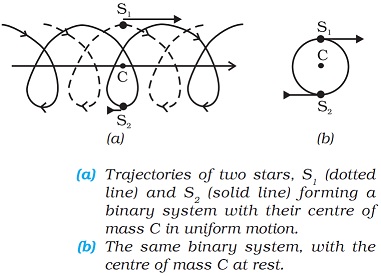
Q10. considering binary (double) stars in our frame of reference, the trajectories of the stars are a combination of
Answer : Option B
Explaination / Solution:

A double star or visual double is a pair of stars that appear close to each other in the sky as seen from Earth when viewed through an optical telescope.

In absence of  external force Centre of mass of double star moves like a free particle. In Centre of mass frame both stars moving in a circle about the Centre of mass which is at rest and both star are diametrically opposite to each other.

Thus in our frame of reference, the trajectories of the stars are a combination of (i) uniform motion in a straight line of the Centre of mass and        (ii) circular orbits of the stars about the Centre of mass.