General Science - Online Test
Q1. Compass needle of known magnetic moment m in a uniform magnetic field field experiences a torque equal to
Answer : Option D
Explaination / Solution:
No Explaination.
Q2. If a sample area comprises of more number of taxonomically unrelated species, this will indicate
Answer : Option C
Explaination / Solution:
Richness is a measure of the number of different kinds of organisms present in a particular area.
A diverse sample area having more number of taxonomically unrelated species will indicate a more diverse sample area.
A sample area is used to know the diversity of a geographical area.
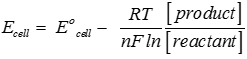
Q3. For a general electrochemical reaction of the type :

Nernst equation can be written as:
Nernst equation can be written as:
Answer : Option D
Explaination / Solution:
Q4. A ‘central’ force is always directed
Answer : Option B
Explaination / Solution:
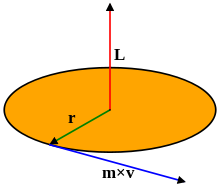
The motion of a particle under a central force F always remains in the plane defined by its initial position and velocity.This may be seen by symmetry. Since the position r, velocity v and force F all lie in the same plane, there is never an acceleration perpendicular to that plane, because that would break the symmetry between "above" the plane and "below" the plane.
To demonstrate this mathematically, it suffices to show that the angular momentum of the particle is constant. This angular momentum L is defined by the equation
Q5. Motion of hole is a convenient way of describing
Answer : Option A
Explaination / Solution:
The holes are just the abscence of a electron in a energy band. But its easier to describe the abscence of a electron as a single moving positive charge than it is to describe the motion of all the other electrons in the band.
In a band you have N electrons. Remove one of those electrons(by for instance p-doping) and you have N-1 electrons left. Now you can either choose to describe this with the behavior of those N-1 electrons. Or you can choose to describe it as if there is one single hole moving around in the band.
So mathematicly the holes behave just like a positivly charged electron.
Q6. Before producer’s equilibrium when MR>MC, the firm earns only
Answer : Option B
Explaination / Solution:
No Explaination.
Q7. Animals of class Mammalia have
Answer : Option C
Explaination / Solution:
The animals of class Mammalia have seven cervical vertebra and four chambered heart. Mammalian are charecterised by presence of mammary gland to feed their young ones.
Q8. Money is something that is
Answer : Option D
Explaination / Solution:
Money is widely accepted as a medium of exchange. It can be used to buy a commodity.
Q9. Pollen grains are formed inside the
Answer : Option D
Explaination / Solution:
Pollen grains are formed inside the anther. Stamen contains filament and anther. Inside the anther microsporogenesis process takes place to produce haploid pollen grains that forms male gametes.
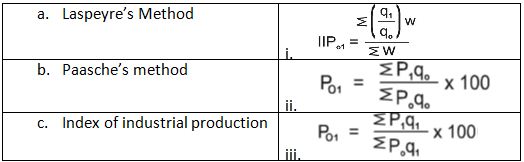
Q10. Match the following. Options are as follows
Answer : Option B
Explaination / Solution:
(i) Laspeyre suggested that for the purposes of calculating Price Indices, the quantities in the base year should be taken as weights.
(ii) Paasche’s method of calculating Price Index, the quantities of the current year are used as weights.
(iii) The Index of Industrial Production (IIP) is an index for India which details out the growth of various sectors in an economy such as mining, electricity and manufacturing.
(ii) Paasche’s method of calculating Price Index, the quantities of the current year are used as weights.
(iii) The Index of Industrial Production (IIP) is an index for India which details out the growth of various sectors in an economy such as mining, electricity and manufacturing.