General Science - Online Test
Q1. Phage is a
Answer : Option A
Explaination / Solution:
Phage is a virus that infects bacteria. Such viruses transfer their genetic materials into host bacteria and using the bacterial machinery increase in number and multiply rapidly to kill host cells.
Q2. The physiological unit of a kidney is :
Answer : Option C
Explaination / Solution:
Nephrons are the physical unit or functional unit of kidney. Millions of nephrons are present in each kidney but physiological unit of kidney is urinigerous tubule.
Q3. Zeroth Law of Thermodynamics
Answer : Option C
Explaination / Solution:
The zeroth law of thermodynamics states that if twothermodynamic systems are each in thermal equilibrium with a third, then they are in thermal equilibrium with each other.
More simply:
if
It is called the zeroth (0th) law of thermodynamics because it was discovered after the others, but people thought it was more important so they wanted to give it a number before the other laws.
Q4. A scientific theory is accepted if
Answer : Option C
Explaination / Solution:
A scientific theory is an explanation of some aspect of the natural world that can, in accordance with the scientific method, be repeatedly tested, using a predefined protocol of observations and experiments.Established scientific theories have withstood rigorous scrutiny and are a comprehensive form of scientific knowledge.
Q5. If we place solid iodine in a closed vessel, after sometime the vessel gets filled up with violet vapour. When equilibrium is attained, the intensity of colour will be
Answer : Option D
Explaination / Solution:
we place solid iodine in a closed vessel, after sometime the vessel gets filled up with violet vapour and the intensity of colour increases with time. After certain time the intensity of colour becomes constant and at this stage equilibrium is attained. Hence solid iodine sublimes to give iodine vapour and the iodine vapour condenses to give solid iodine. The equilibrium can be represented as, I2 (solid) ⇌ I2 (vapour)
Q6. Who performed the famous experiment to prove origin of life?
Answer : Option A
Explaination / Solution:
The famous experiment to prove the origin of life from inorganic substance was performed by Urey and Miller in 1953 by creating similar condition in laboratory as earth would be at the time of origin of life.
Q7. The average Kinetic energy and Thermal energy are proportional to the
Answer : Option C
Explaination / Solution:
The average KE and Thermal energy are proportional to absolute Temperature.
The kinetic energy is the amount of motion in the atoms and molecules of a substance. The moleculess of the gas gain energy as the temperature increases as there is more motion of the molecules. As the temperature decreases the motion lessens until at absolute zero all motion (kinetic energy) stops.
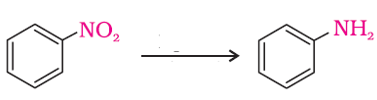
Q8. The following reaction takes place in the presence of
Answer : Option A
Explaination / Solution:
-NO2 group is reduced to –NH2 using H2/Pd.
Q9. The meristems which occur at the tips of roots and shoots and produce primary tissues are called
Answer : Option B
Explaination / Solution:
Apical meristem is found at the apices, or tips of the plant, both the tip of the shoot and the root, and is a region of actively dividing cells. The definition is easy to remember when you break it down. An apex is the tip, the very end, of something.
Q10. The differentiated cells have lost the capacity to divide can regain the capacity of division under certain conditions called as
Answer : Option B
Explaination / Solution:
The living differentiated cells that have lost the capacity to divide can regain the capacity of division under certain conditions. This phenomenon is termed as dedifferentiation.