General Science - Online Test
Q1. Which among the following substances is an example of multimolecular colloids?
Answer : Option A
Explaination / Solution:
Multimolecular colloids are formed when a large number of atoms or molecules of a substance aggregate together to form speices having size in colloidal range. sulphur sol contains a thousand of S8 molecules.
Q2. A point charge + q is placed at the mid point of a cube of side L. The electric flux emerging from the cube is
Answer : Option B
Explaination / Solution:
Since the charge inside cube is q so by Gauss theorem the total flux through the cube is
Q3. In between two walls of adjacent cells are seen
Answer : Option B
Explaination / Solution:
The middle lamella cements the tertiary walls of two adjacent plant cells. It is formed out of materials of cell plate.
Q4. How bacterial cells protect themselves from the action of their own restriction enzymes?
Answer : Option D
Explaination / Solution:
The protection is offered by the action of the methylase. The methylase recognizes the same target site as the restriction enzyme and adds a methyl group to a specific nucleotide in the restriction site. Methylated sites are not substrates for the restriction enzyme.
The bacterial DNA is methylated immediately following replication so it will not be a suitable substrate for restriction endonuclease cleavage.
Thus, the viral DNA is restricted in the bacterial cell by the restriction enzyme, and the bacterial DNA is modified by the methylase and is provided protection.
Q5.
Compute the fractional change in volume of a glass slab, when subjected to a hydraulic pressure of 10 atm. Bulk modulus of glass 37 GPa.
Answer : Option B
Explaination / Solution:
No Explaination.
Q6.
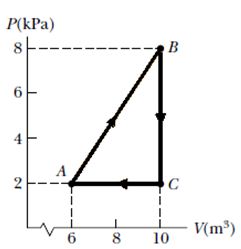
Consider the cyclic process depicted in Figure If Q is negative for the process BC, and if is negative for the process CA, what are the signs of Q, W, and that are associated with AB?
Answer : Option C
Explaination / Solution:
W = +ve (Expansion)
Q7. Adaptive ability is inherited because
Answer : Option D
Explaination / Solution:
An adaptive behavior is a behavior which contributes directly or indirectly to an individual's survival or reproductive success and is thus subject to the forces of natural selection.
The adaptive ability of an organism is inherited to their next generation because it has genetic basis. The adaptive traits arise due to change in gene.
Q8. As the temperature increases, average kinetic energy of molecules increases. What would be the effect of increase of temperature on pressure provided the volume is constant?
Answer : Option C
Explaination / Solution:
P α T at constant volume.This is according to Gay Lussac’s law-“ At constant volume, the pressure of a given mass of a gas is directly proportional to its absolute temperature.”
Q9. A metal in a compound can be displaced by another metal in the uncombined state. Which metal is a better reducing agent in such a case?
Answer : Option B
Explaination / Solution:
Reducing agent is one in which element undergo oxidation itself and make the other substance reduce.
Q10. Which genus has large number of closely related species
Answer : Option D
Explaination / Solution:
A genus consists of large number of closed related species. Genus Solanumconsistof larger of common species that includes, potato, tomato, Brinjalect.