General Science - Online Test
Q1. The catalyst used in Deacon’s process is
Answer : Option A
Explaination / Solution:
CuCl2 is used as catalyst in Decon’s Process.
Q2. behaves as a bleaching agent because:
Answer : Option C
Explaination / Solution:
Because it can undergo bond dissociation randomly in presence of light. It dissociates and generates free radicals which is very reactive and acts like bleaching agent.
Q3. Large proportion of cultivated plants are
Answer : Option A
Explaination / Solution:
Cultivated plants are mostly allopolyploids that contain multiple sets of genetic material in their cells. Bread wheat is generally hexaploid. Allopolyploids occurs due to faulty karyokinesis.
Q4. A short bar magnet has a magnetic moment of 0.48 J/T .Magnetic field produced by the magnet at a distance of 10 cm from the centre of the magnet on the axis has a direction and magnitude of .
Answer : Option B
Explaination / Solution:
No Explaination.
Q5. A beam of light consisting of two wavelengths, 650 nm and 520 nm, is used to obtain interference fringes in a Young’s double-slit experiment. Find the distance of the third bright fringe on the screen from the central maximum for wavelength 650 nm.
Answer : Option B
Explaination / Solution:
No Explaination.
Q6. Endemics of western Ghats include
Answer : Option B
Explaination / Solution:
Endemism is the ecological state of a species being unique to a defined geographic location, such as an island, nation, country or other defined zone, or habitat type.
Notable endemics are the Nilgiri leaf monkey and the brown and carmine Beddome's toad of the Western Ghats.
Q7. The IUPAC name of AlCl3.4(EtOH) is
Answer : Option D
Explaination / Solution:
This is double salt so name is written in sequential manner.
Q8. A reptile having four chambered heart is
Answer : Option B
Explaination / Solution:
Reptiles generally possess three chamber heart, two upper chamber and single lower chamber. But in crocodile, the heart is four chambered having two atrium and two ventricles.
Q9. Raising CRR by the central bank in India during excess demand will be
Answer : Option B
Explaination / Solution:
No Explaination.
Q10. When we apply reverse bias to a junction diode it
Answer : Option C
Explaination / Solution:
When a diode is connected in a Reverse Bias condition, a positive voltage is applied to the N-type material and a negative voltage is applied to the P-type material.
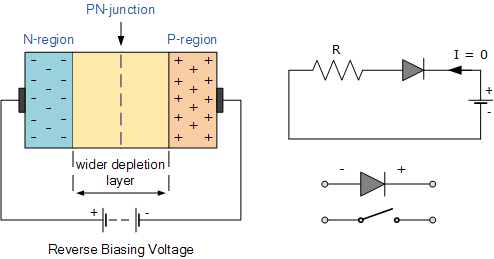
The positive voltage applied to the N-type material attracts electrons towards the positive electrode and away from the junction, while the holes in the P-type end are also attracted away from the junction towards the negative electrode.
The net result is that the depletion layer grows wider due to a lack of electrons and holes and presents a high impedance path, almost an insulator. The result is that a high potential barrier is created thus preventing current from flowing through the semiconductor material