General Science - Online Test
Q1. RAM means:
Answer : Option A
Explaination / Solution:
No Explaination.


Q2. The correct sequential order of pathway is
Answer : Option A
Explaination / Solution:

There is a sequential, orderly pathway functioning, with one substrate forming the next and with glycolysis, TCA cycle and ETS pathway following one after another.

Q3. When ultraviolet light of wavelength 1000  is incident on molybdenum, then the maximum velocity of ejected electron (given: work function of molybdenum = 5.0eV) is
Answer : Option C
Explaination / Solution:
No Explaination.


Q4. Metal carbonates decompose on heating to give metal oxide and carbondioxide. Which of the metal carbonates is most stable thermally?
Answer : Option D
Explaination / Solution:

is very stable due to size compatibility factor . A larger cation can stablise a larger anion.Group 2 element become more thermally stable down the group.

Q5. A message signal of frequency 10 kHz and peak voltage of 10 volts is used to modulate a carrier of frequency 1 MHz and peak Voltage of 20 volts. Determine the modulation index
Answer : Option A
Explaination / Solution:
No Explaination.


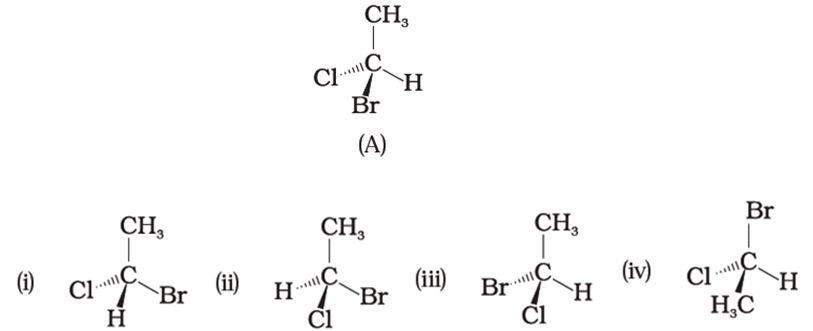
Q6. In which of the following representations given below spatial arrangement of group/ atom different from that given in structure ‘A’?

Answer : Option A
Explaination / Solution:
No Explaination.


Q7. The Breakeven level of an economy is
Answer : Option B
Explaination / Solution:
No Explaination.


Q8. Indian economy at the time of independence was
Answer : Option D
Explaination / Solution:

High growth of population, lower level of human development, agricultural dominance, unequal distribution of income and wealth, scarce resources of production, high rate of unemployment, high dependency ratio, lack of entrepreneurs and low level of technology reflect Backward economies at the time of independence.

Q9. Order of the photochemical reaction occurring between hydrogen and chlorine is
Answer : Option B
Explaination / Solution:

Photochemical reaction between  and is 0 zero wrt to reactants.

Q10. In a cumulative percent frequency distribution, the last class will have a cumulative percent frequency equal to
Answer : Option C
Explaination / Solution:

Cumulative percentage is another way of expressing frequency distribution. It calculates the percentage of the cumulative frequency within each interval, much as relative frequency distribution calculates the percentage of frequency.

The main advantage of cumulative percentage over cumulative frequency as a measure of frequency distribution is that it provides an easier way to compare different sets of data.

Cumulative frequency and cumulative percentage graphs are exactly the same, with the exception of the vertical axis scale. In fact, it is possible to have the two vertical axes, (one for cumulative frequency and another for cumulative percentage), on the same graph.

Cumulative percentage is calculated by dividing the cumulative frequency by the total number of observations (n), then multiplying it by 100 (the last value will always be equal to 100%