General Science - Online Test
Q1. Transistor was invented by
Answer : Option C
Explaination / Solution:
A transistor is a semiconductor device used to amplify or switch electronic signals and electrical power. It is composed of semiconductor material usually with at least three terminals for connection to an external circuit.
The first practically implemented device was a point-contact transistor invented in 1947 by American physicists John Bardeen, Walter Brattain, and William Shockley.
The transistor revolutionized the field of electronics, and paved the way for smaller and cheaper radios, calculators, and computers, among other things.
The transistor is on the list of IEEE milestones in electronics, and Bardeen, Brattain, and Shockley shared the 1956 Nobel Prize in Physics for their achievement.
Q2. A monthly price index that measures the changes in the prices of goods sold in a primary market is known as the
Answer : Option B
Explaination / Solution:
No Explaination.
Q3. The number of polar bodies formed during oogenesis in human being is
Answer : Option A
Explaination / Solution:
During oogenesis reduction division occurs in primary oocytes to produce one polar body and secondary oocytes. Polar bodies further divide to form two polar bodies. Secondary oocytes further divide to produce one polar bodies and a secondary follicle to produce ovum.
Q4. Indicator/s of growth in the educational sector
Answer : Option A
Explaination / Solution:
Growth in education includes parameters like literacy rate, number of educational institutions and the student enrolment.
Q5.
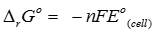
For the reduction of silver ions with copper metal the standard cell potential was found to be +0.46V at 25°C. The value of standard Gibbs energy, ΔG° wll be (F = 96500 C )
Answer : Option A
Explaination / Solution:
Q6. Thermodynamics is not concerned about
Answer : Option B
Explaination / Solution:
Thermodynamics on tells that whether reaction will give take place or not. It doesnot tell the rate at which reaction will occur.
Q7.
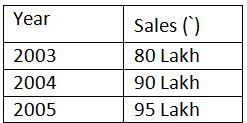
Identify the type of classification used in the following table
Answer : Option A
Explaination / Solution:
When data are observed over a period of time the type of classification is known as chronological classification
Q8. Cost-push inflation
Answer : Option D
Explaination / Solution:
No Explaination.
Q9.
A truck has a velocity of 2 m /s at time t=0. It accelerates at 2 m / on seeing police .What is its velocity in m/s at a time of 2 sec
Answer : Option C
Explaination / Solution:
Initial velocity u = 2 m/s
final velocity = v m/s
Time duration = final time - initial time = 2-0 = 2 s
acceleration a = 2 m/s2
We know,
v = u + at
=> v =
=> v = 6 m/s
Q10. A stretched string fixed at both ends has n nodes then the length of string in terms of wavelength is
Answer : Option B
Explaination / Solution:
No Explaination.