General Science - Online Test

Q1. The typical range of molar enthalpies for the strongest intermolecular (Hydrogen) bonds is
Answer : Option C
Explaination / Solution:

A hydrogen bond is the electrostatic attraction between two polar groups that occurs when a hydrogen (H) atom linked to a small sized highly electronegative atom such as nitrogen (N), oxygen (O), or fluorine (F). Therefore unlike a covalent bond, it has very low dissociation energy with a range of molar enthalpy = ( 4 − 25 ) kJ

Q2. What causes an economy to produce more of Good X and no less of Good Y?
Answer : Option D
Explaination / Solution:

Technology is the advancement of the society as a whole. Better technology means that you can figure out more efficient production techniques thereby leading the economy to create a scope to move the PPC further to the right

Q3. Match the ear part and their shapes :
column A
a) Stapes
b) External auditory canal
c) Malleus
d) Incus

column B
i) anvil shaped
ii) hammer shaped
iii)S- shaped
iv) stir-up shaped
Answer : Option A
Explaination / Solution:

There are three differentkinds of bone present in middle ear of human beings to amplify the sound receivedby ear. Stapes is stir-up shaped, external auditory canal is S-shaped, Malleus is hammer shaped and incus is anvil shaped.

Q4. The situation of ‘normal profits’ arise for a firm when
Answer : Option A
Explaination / Solution:
No Explaination.


Q5. Deforestation is responsible for:
Answer : Option B
Explaination / Solution:

Deforestation is responsible for desertification

Q6.

A brass boiler has a base area of 0.15 m2 and thickness 1.0 cm. It boils water at the rate of 6.0 kg/min when placed on a gas stove. Estimate the temperature of the part of the flame in contact with the boiler. Thermal conductivity of brass = 109 J  ; Heat of vaporization of water = 2256 


Answer : Option D
Explaination / Solution:

Base area of the boiler, = 0.15 m2
Thickness of the boiler, l = 1.0 cm = 0.01 m
Boiling rate of water, R = 6.0 kg/min
Mass, m = 6 kg
Time, t = 1 min = 60 s
Thermal conductivity of brass, K = 109 J s –1 m–1 K–1
Heat of vaporisation, L = 2256 × 103 J kg–1
The amount of heat flowing into water through the brass base of the boiler is

     ..........(1)

where,
T1 = Temperature of the flame in contact with the boiler
T2 = Boiling point of water = 100°C 
Heat required for boiling the water

Q = mL  ....… (ii)
Equating equations (i) and (ii), we get:
∴ mL = KA(T1 - T2t / 
T1 - T2 = mLl / KAt
= 6 × 2256 × 103 × 0.01 / (109 × 0.15 × 60)
= 137.98 o C
Therefore, the temperature of the part of the flame in contact with the boiler is 237.98°C.


Q7. Lines in the hydrogen spectrum which appear in the visible region of the electromagnetic Spectrum, then they are called as
Answer : Option C
Explaination / Solution:

The Balmer series or Balmer lines in atomic physics, is the designation of one of a set of six named series describing the spectral line emissions of the hydrogen atom. The Balmer series is calculated using the Balmer formula, an empirical equation discovered by Johann Balmer in 1885 Balmar series lies in visible region of Electromagnetic spectrum.

Q8. Number of pairs of observations of x and y series = 10
X series: Arithmetic average = 65
Standard deviation = 23.33
Y series: Arithmetic average = 66
Standard deviation = 14.9
Summation of products of corresponding deviation of X and Y series = + 2704
Calculate product moment correlation of x and y series.
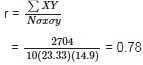
Answer : Option A
Explaination / Solution:


Q9. Integrated rural development programme, Development of women and children in rural areas , Million wells scheme etc. all these amalgamated into a single self-employment programme known as
Answer : Option C
Explaination / Solution:

Swarnajayanti Gram Swarojgar Yojana (SGSY) is an initiative launched by the Government of India to provide sustainable income to poorest of the poor people living in rural & urban areas of the country.

Q10. The phenomenon of having two types of spores by the same plant is called
Answer : Option A
Explaination / Solution:

The phenomenon of having two types of spores by the same plant is called heterospory. Male spores are small ( micro) and female spores are comparatively larger ( macro)than males like Selaginella and Salvinia are heterosporous.