General Science - Online Test
Q1. Price taker firms
Answer : Option C
Explaination / Solution:
No Explaination.
Q2. XO type of sex determination is found in
Answer : Option C
Explaination / Solution:
In grasshopper, sex determination is of XO type, in which the males have only one X-chromosome besides the autosomes whereas females have a pair of X-chromosome.
Q3. What is the common name of Drosophila melanogaster?
Answer : Option D
Explaination / Solution:
Drosophila melanogaster is a species of fly (the taxonomic order Diptera) in the family Drosophilidae. The species is known generally as the common fruit fly or vinegar fly. A number of experiments related to inheritance of trait were carried out on this small fly.
Q4. Match the following:
column A
a)Waller
b) Landsteiner
c) de castello and Steini
d) Landsteiner and Weiner
column B
i) rhesus antigen
ii) first ECG
iii) A, B and O blood group
iv) AB blood group
column A
a)Waller
b) Landsteiner
c) de castello and Steini
d) Landsteiner and Weiner
column B
i) rhesus antigen
ii) first ECG
iii) A, B and O blood group
iv) AB blood group
Answer : Option C
Explaination / Solution:
Waller performed first ECG. Landsteiner and Weiner discovered rhesus antigen (Rh). De castello and Steini shows the AB blood grouping and Landsteiner A,B,O blood grouping.
Q5. When is converted into
Answer : Option A
Explaination / Solution:
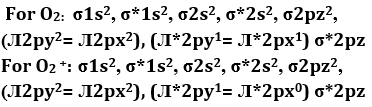
Bond order =
For O2 = = 2
For O2+ = = 2.5
Q6. An air-cored solenoid with length 30 cm, area of cross-section 25 and number of turns 500, carries a current of 2.5 A. The current is suddenly switched off in a brief time of s. Average back emf induced across the ends of the open switch in the circuit is
Answer : Option A
Explaination / Solution:
ϕ=NBA=μ0N2Ail|e|=dϕdt
Q7. Use the formula T = 0.29 cmK to obtain the characteristic temperature range for m
Answer : Option C
Explaination / Solution:
No Explaination.
Q8. Which of the following will be able to cope with greenhouse effect
Answer : Option A
Explaination / Solution:
Greenhouse effect causes increase in temperature of earth.
Warm-blooded animal species can maintain a body temperature higher than their environment. In particular, homeothermic species maintain a stable body temperature by regulating metabolic processes. The only known homeotherms are birds and mammals.
Homeotherms can tolerate high temperature. So, homeotherms will be able to cope with the effect of green house effect.
Q9. Net gain of ATP molecules per hexose during aerobic respiration is
Answer : Option D
Explaination / Solution:
Each glucose (hexose) during complete oxidation or aerobic respiration produce net 36 ATP molecules, which is produced in form of NADPH and FADH. Each NADPH produce 3 ATP and FADH two ATP molecules.
Q10.
A hydrocarbon C5H10 does not react with chlorine in dark but gives a single monochloro compound
C5H9C l in bright sunlight. The hydrocarbon is
Answer : Option D
Explaination / Solution:
Alkanes undergoes halogenations in prrsence of light.