General Science - Online Test
Speed of the cyclist, v = 27 km/h = 7.5 m/s
Radius of the circular turn, r = 80 m
Centripetal acceleration is given as:
ac = 0.7 ms-2
The situation is shown in the given figure:
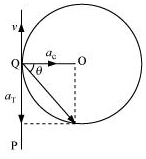
Suppose the cyclist begins cycling from point P and moves toward point Q. At point Q, he applies the breaks and decelerates the speed of the bicycle by 0.5 m/s2.
This acceleration is along the tangent at Q and opposite to the direction of motion of the cyclist.
Since the angle between ac and aT is 900, the resultant acceleration a is given by:
a =
= = 0.86 ms-2
tan θ =
where θ is the angle of the resultant with the direction of velocity.
tan θ = = 1.4
θ = tan-1(1.4) = 54.56° with the direction of velocity

A 1.0-mol sample of an ideal gas is kept at 0.0C during an expansion from 3.0 L to 10.0 L. How much work is done by the gas during the expansion?
In isothermal process