General Science - Online Test

Q1. Period of a periodic motion is the ________ interval of time after which the motion is __________.
Answer : Option B
Explaination / Solution:

Time period of an oscillatory motion is the smallest interval of time for one complete oscillation.As when we apply the force on the bob,bob moves from mean position to extreme position then form extreme position to mean position and then again from mean to extreme in opposite direction and at last come to mean position.The time taken by bob in this whole process is called period of oscillation.

Q2. Which of the following can be categorised as a photoautotroph ?
Answer : Option D
Explaination / Solution:

Photoautotrophs are organism that perform photosynthesis in presence of sunlight. Euglena contains chlorophyll and fixes the solar energy so, it acts as photoautotrophs.

Q3. A group of atoms can function as a ligand only when
Answer : Option D
Explaination / Solution:

Ligands are electron donors.

Q4. wave front is
Answer : Option D
Explaination / Solution:

a locus of points, which oscillate in phase is called a wavefront; thus a wavefront is defined as a surface of constant phase. The speed with which the wavefront moves outwards from the source is called the speed of the wave.

Q5. Hydrogen has three isotopes: protium, deuterium, and tritium. Which of them is radioactive and emits beta particles ?
Answer : Option A
Explaination / Solution:

Due to unfavourable neutron to proton ratio, tritium emits low energy beta particles.

Q6. Taichung Native-1”, a rice variety was introduced in India from
Answer : Option D
Explaination / Solution:

Taichung Native-1 is a rice variety introduced in India from Taiwan. This variety of rice is medium sized having long inflorescence. The maturity period is also shorter than usual varieties of rice.

Q7. Which of the following statements about magnetic field lines true?
Answer : Option D
Explaination / Solution:
No Explaination.


Q8. Fundamental difference between an electrolytic cell and the galvanic cell is that in an electrolytic cell free energy
Answer : Option C
Explaination / Solution:

In electrolytic cell electrical energy is converted into chemical energy.

Q9. When we compare the relationship between species richness and area for wide variety of taxa, the graph appears to be a :
Answer : Option A
Explaination / Solution:

Explanation:
  • Alexander Von Humboldt has observed that within a region, species richness gets increased when explored area is increased, but only up to a limit.
  • The relationship between species richness and area for a number of taxa like angiospermic plants, fresh water fishes and birds is found to be a rectangular hyperbola.
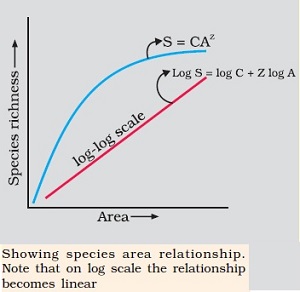
The equation is described by –

log S = log C + Z log A

S – Species Richness

Z – Slope of the line (regression coefficient)

A – Area

C – y-intercept


Q10.

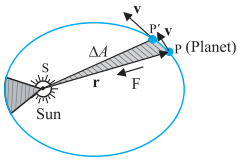
The area A swept out by a planet of mass m in time interval t is related to the angular momentum by:

Answer : Option B
Explaination / Solution:


The law of areas can be understood as the consequence of conservation of angular momentum which is valid for any central for A central force is such that the force on the planet is along the vector joining the sun and the planet. Let the sun be at the origin and let the position and momentum of the planet be denoted by r and p  respectively. Then the area swept out by the planet of mass m in the time interval Δt is given by ΔA = ½  (r × vΔt).

Hence ΔA/Δt    =½ (r × p)/m, (since  v=p/m)    

                 =    L / (2 m) 

where v is the velocity,  where v is the velocity,  L is the angular
momentum equal to   ( r  ×  p  ).  For a central force, which is directed along r, L is a constant