General Science - Online Test
The genetic code is the set of "rules" that a cell uses to interpret the nucleotide sequence within a molecule of mRNA. This sequence is broken into a series of three-nucleotide units known as codons.
The three-letter nature of codons means that the four nucleotides found in mRNA — A, U, G, and C — can produce a total of 64 different combinations. Of these 64 codons, 61 represent amino acids, and the remaining three represent stop signals, which trigger the end of protein synthesis.
Because there are only 20 different amino acids but 64 possible codons, most amino acids are indicated by more than one codon. ( however, that each codon represents only one amino acid or stop codon.).
This phenomenon is known as redundancy or degeneracy, and it is important to the genetic code because it minimizes the harmful effects that incorrectly placed nucleotides can have on protein synthesis.
VR = (1.20 V) cos(2500 rad/s)t
ω=2500rad/s
C=5μF=5×10⁻⁶F
Capacitive reactance
XC=1ωC=12500×5×10−6=80Ω
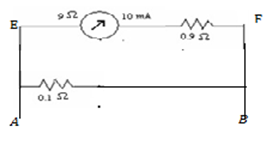
Thee above circuit can be redrawn as:
Total resistance in the arm EF ( milliammeter and the 0.9Ω resistor)= 9+0.9=9.9Ω.
Since the milliammeter gives full scale deflection when A and B are used as its terminals, the current in the arm EF is 10 mA. The potential difference across the arm is
VEF = Ig* R = 10(10^ - 3) * 9.9 = 0.099V.
The potential difference across AB= potential diff across the 0.1Ω resistor= VEF = 0.099 V.
The current through the 0.1Ω resistor
The total current I is the sum of I0.1 and Ig
= Ig + I0.1 = 0.01 + 0.99 = 1A.