General Science - Online Test
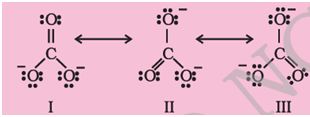
Q1. Structures of . ion given below explains the phenomenon of _____________.
Answer : Option D
Explaination / Solution:
Resonance is the phenomenon when a molecule can be represented by 1 or more structure differing in the position of bonds and charge.
Q2. Secondary treatment of sewage is also called
Answer : Option C
Explaination / Solution:
Secondary treatment of sewage is also called biological treatment because in this treatment aeration of sewage water is done that increase the microbes that decompose the organic materials in sewage water.
Q3. Damping in galvanometers is based on
Answer : Option D
Explaination / Solution:
The coil of galvanometer is wound on a light metal frame. When the coil and frame rotate in the field of the permanent magnet, the eddy current set up in the frame oppose the motion so that the coil returns to zero quickly.
Q4. Photons can be
Answer : Option D
Explaination / Solution:
If photon strike with loosely bound electron then photoelectric effect takes place.Collision of photon with completely free electron give rise to Compton effect or Compton scattering.
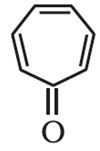
Q5. The following compound is:
Answer : Option D
Explaination / Solution:
Tropone or 2,4,6-cycloheptatrien-1-one is a non-benzenoid aromatic compound. The compound consists of a ring of seven carbon atoms with three conjugated alkene groups and a ketone group.
Q6. Low BOD will be characteristic feature of :
Answer : Option B
Explaination / Solution:
Low biological oxygen demand (BOD) will be characteristic feature of an oligotrophic lake. In oligotrophic lake concentration of nutrients are very low so a few organisms only survive and BOD is comparatively low.
Q7. Carbon – halogen bond of alkyl halides is responsible for their nucleophilic substitution, elimination and their reaction with metal atoms to form organometallic compounds because of their
Answer : Option D
Explaination / Solution:
R—X is polar.
Q8. Megahertz (MHz) measures
Answer : Option B
Explaination / Solution:
No Explaination.
Q9. Flame photometry is used to determine the concentration of the
Answer : Option D
Explaination / Solution:
Flame photometry is used to determine the concentration of alkali metalions, alkaline earth metals are quite sensitive to flame photometry.
Q10. FM Radio set used in cars is
Answer : Option D
Explaination / Solution:
Radio means sending energy with waves. In other words, it's a method of transmitting electrical energy from one place to another without using any kind of direct, wired connection. That's why it's often called wireless. The equipment that sends out a radio wave is known as a transmitter; the radio wave sent by a transmitter whizzes through the air—maybe from one side of the world to the other—and completes its journey when it reaches a second piece of equipment called a receiver((here a radio).