General Science - Online Test
Q1. The unit of charge is
Answer : Option C
Explaination / Solution:
The SI unit of quantity of electric charge is the coulomb, which is equivalent to about 6.242×10¹⁸ e (e is the charge of a proton).
Hence, the charge of an electron is approximately −1.602×10⁻¹⁹ C. The coulomb is defined as the quantity of charge that has passed through the cross section of an electrical conductor carrying one ampere within one second. The symbol Q is often used to denote a quantity of electricity or charge.
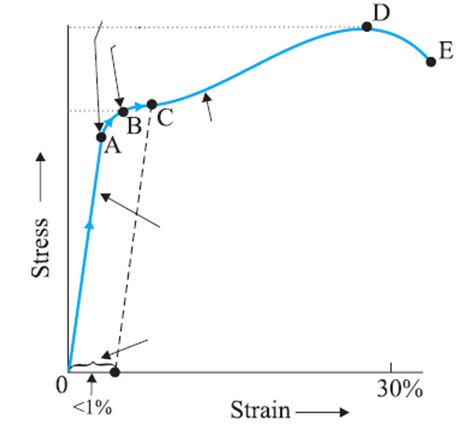
Q2. With reference to figure the yield point corresponds to
Answer : Option D
Explaination / Solution:
No Explaination.
Q3. Restriction enzymes belongs to a larger class of enzymes called
Answer : Option B
Explaination / Solution:
A restriction enzyme (or restriction endonucleases) recognizes a specific base pair sequence in DNA called a restriction site and cleaves the DNA (hydrolyses the phosphodiester backbones) within the sequence. Restriction enzymes are widely found in prokaryotes and provide protection to the host cell by destroying foreign DNA that makes entry to it. It acts as a part of defense mechanism.
Restriction enzymes belong to a larger class of enzymes called nucleases. They are of two types: endonucleases and exonucleases.
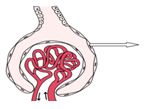
Q4. Label the following in diagram
Answer : Option B
Explaination / Solution:
The diagram shown above is Malpighian body or renal corpuscles. The marked part in this is called Podocytes or visceral epithelial cells in Bowman’s capsule in the kidney that warp around capillaries of the glomerules.
Q5. In Thermodynamics Extensive variables depend
Answer : Option D
Explaination / Solution:
The variables which depend on the size or amount of the substance are called extensive variables.
Example: Mass, volume etc
Q6. The experiment to show the production of mice in 21 days from a dirty shirt placed in Contact with kernels of wheat was carried out by ______.
Answer : Option C
Explaination / Solution:
The first experiments to prove the spontaneous generation theory were done in the XVII century and a doctor called Jean Baptiste Van Helmont declared he had performed a unique experiment: he placed a dirty shirt together with some wheat and according to him, mice were born 21 days later.
According to the Doctor the sweat in the shirt was the active element which gave life to the inert matter.
Q7. Which of the following is the correct ideal gas law
Answer : Option D
Explaination / Solution:
PV=nRT is the correct Ideal Gas equation.
Here, P : Pressure
V : Volume
n : Number of Moles
R : Universal Gas Constant
T : Temperature
Q8. The aqueous solution of sugar does not conduct electricity. However, when sodium chloride is added to water, it conducts electricity. How will you explain this statement on the basis of ionisation and how is it affected by concentration of sodium chloride?
Answer : Option B
Explaination / Solution:
Sugar being a non-electroyte, does not ionize in water, whereas NaCl ionizes completely in water and produce Na+ and Cl- ions, which help in the conduction of electricity and when concentration of NaCl is increased , more Na+ and Cl- ions will be produced, hence conductance increases.
Q9. The cyclic form of fructose is called
Answer : Option A
Explaination / Solution:
Cyclic form of fructose is called furanose.
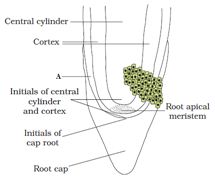
Q10. In monocotyledons, guard cell of stomata areThe figure given below is the apical meristem in root. Identify ‘A’ in the diagram.
Answer : Option D
Explaination / Solution:
The part ‘A’ is protoderm in apical meristem of root.