General Science - Online Test
Q1. By which year governments are aiming to meet the Millennium Development Goals including halving the rate of global poverty?
Answer : Option A
Explaination / Solution:
The Millennium Development Goals (MDGs) are the world's time-bound and quantified targets for addressing extreme poverty in its many dimensions-income poverty, hunger, disease, lack of adequate shelter, and exclusion-while promoting gender equality, education, and environmental sustainability.
Q2. Agar is obtained from
Answer : Option D
Explaination / Solution:
Agar, one of the commercial products obtained from Gelidium are used to grow microbes and in preparations of ice-creams and jellies.
Q3. The smallest free living organism are
Answer : Option B
Explaination / Solution:
PPLO (Pleuro Pneumonia Like Organisms). They are generally smaller and multiply more rapidly than the eukaryotic cells.
Q4. One of the drawbacks of the Direct personal investigation method is ______.
Answer : Option C
Explaination / Solution:
Here, the investigator himself visits the persons those are source of the data and collects necessary information either through interview with the persons concerned or through observation of the data on the spot due to which this method is costly as well as time taking.
Q5. Factor contributing to global warming
Answer : Option D
Explaination / Solution:
Burning of coal and petroleum products are source of gases like carbon dioxide, methane , nitrous oxide and ozone.Presence of all these gases in atmosphere causes global warming.
Q6. Beadle and Tatum showed that each kind of mutant bread mould they studied lacked a specific enzyme. Their experiments demonstrated that
Answer : Option B
Explaination / Solution:
Sir Archibald Garrod, a British medical doctor, was the first to suggest that genes were connected to enzymes.
George W. Beadle (1903-1989) and Edward L. Tatum (1909-1975) show genes direct the synthesis of enzymes that control metabolic processes using genetic and biochemical studies of the bread mold Neurospora.
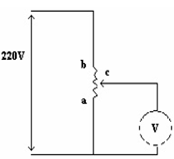
Q7. A potential difference of 220 V is maintained across 12000 rheostat. Then voltmeter V has a resistance of 6000 and point C is at one fourth the distance from a to b. Then the reading of voltmeter is
Answer : Option B
Explaination / Solution:
Resistance R = 1/4R = 12000/4 = 3000 parallel. .

This is in series with Rbc.
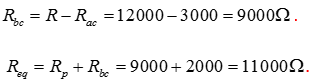
The current in the circuit I = 220/11000 = 0.02A The reading of the voltmeter is the potential drop across Rp. V = 0.02 * 2000 = 40V
This is in series with Rbc.
The current in the circuit I = 220/11000 = 0.02A The reading of the voltmeter is the potential drop across Rp. V = 0.02 * 2000 = 40V
Q8. The time period of a simple pendulum is given by ( l is length of pendulum and g the acceleration due to gravity)
Answer : Option C
Explaination / Solution:
No Explaination.
Q9. When the main pool is located in the soil and rocks, that nutrient cycle is called
Answer : Option D
Explaination / Solution:
The nutrient cycle in which reservoir is located in earth crust is called sedimentary nutrient cycle. So, soil and rock based nutrient cycles are example of sedimentary nutrient cycle.
Q10. Interference effects of light from two sources can be observed if
Answer : Option C
Explaination / Solution:
If the two sources are coherent, then the phase difference φ at any point will not change with time and we will have a stable interference pattern; i.e., the positions of maxima and minima will not change with time.