General Science - Online Test
Q1. The net direction and rate of osmosis depends on
Answer : Option D
Explaination / Solution:
The diffusion of water across a semi-permeable membrane from high concentration of water (or low solute concentration) to low concentration of water (or high solute concentration) is called osmosis.
The net direction and rate of osmosis depends on two factors: concentration gradient and pressure gradient.
Q2. The stream line in a flow is
Answer : Option A
Explaination / Solution:
Streamlines, streaklines and pathlines are field lines in a fluid flow. They differ only when the flow changes with time, that is, when the flow is not steady. Considering a velocity vector field in three-dimensional space in the framework of continuum mechanics, we have that:
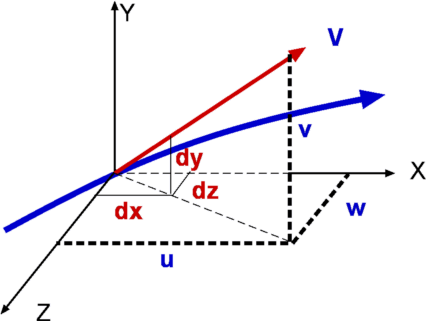
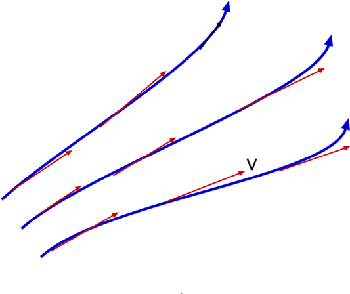
Streamlines are a family of curves that are instantaneously tangent to the velocity vector of the flow. These show the direction in which a massless fluid element will travel at any point in time
A streamline is one that drawn is tangential to the velocity vector at every point in the flow at a given instant and forms a powerful tool in understanding flows. This definition leads to the equation for streamlines.
where u,v, and w are the velocity components in x, y and z directions respectively as sketched.
Q3. Calorimetry is a branch of science dealing with
Answer : Option B
Explaination / Solution:
Calorimetry is a branch of science dealing with measuring the amount of energy transferred as heat
Q4. Fibroblasts, macrophages and mast cells are present in
Answer : Option D
Explaination / Solution:
Apart from being connective tissue, Areolar tissue is also protective in nature. It has large number of fibroblast cells which produce fibres. Mast cells, plasma cells and macrophages help to protect against pathogens and aid in tissue repair.
Q5. Who is called as “Father of taxonomy”
Answer : Option D
Explaination / Solution:
Carl Linnaeus. Carl Linnaeus, also known as Carl von Linné or Carolus Linnaeus, is often called the Father of Taxonomy. His system for naming, ranking, and classifying organisms is still in wide use today (with many changes
Q6. The economic reforms were intended to take the Indian economy into three specific directions which are
Answer : Option A
Explaination / Solution:
The economic reforms, popularly known as the NEP (New Economic Policy) of 1991 were intended to take the Indian economy in the direction of Liberalisation, Privatisation and Globalisation (LPG) by removing the restrictions on trade, private sector and reduce the role of government in many areas.
Q7. If domestic autonomous demand increases by 100, in a closed economy output will increase by
Answer : Option A
Explaination / Solution:
No Explaination.
Q8. Absolute measures of dispersion are
Answer : Option A
Explaination / Solution:
These measures give us an idea about the amount of dispersion in a set of observations. They give the answers in the same units as the units of the original observations. When the observations are in kilograms, the absolute measure is also in kilograms.
Q9. The hormone causing release of milk after the birth of young one is :
Answer : Option D
Explaination / Solution:
Mammary glands start releasing milk after parturition. The hormone causing release of milk after the birth of young one is Oxytocin.
Q10. According to IUPAC nomenclature for elements with Z greater than 100,the root 'sept' corresponds to the digit:
Answer : Option B
Explaination / Solution:
Sept is for 7.
Numerical 0 1 2 3 4 5 6 7 8 9
roots nil un bi tri quad pent hex sept oct en