General Science - Online Test
Q1. When the soda bottle is opened, some of the dissolved carbon dioxide gas escapes because of
Answer : Option D
Explaination / Solution:
Soda water, like other carbonated beverages, contains carbon dioxide that has dissolved under pressure. When the pressure is released by opening the soda container, the liquid cannot hold as much carbon dioxide, so the excess bubbles out of the solution. If the soda is left open, additional carbon dioxide will slowly escape into the air. Under warm conditions, the carbon dioxide leaves the solution faster.
Q2. Which one is not a xylem cell?
Answer : Option C
Explaination / Solution:
Xylem is a complex tissue, which consists of four kinds of cells. These cells are tracheid, vessels, xylem parenchyma and xylem fibers. Companion cell is part of phloem tissue.
Q3. Newtonian mechanics could not explain
Answer : Option B
Explaination / Solution:
When science progressed into the realm of the microscopic, of dimensions the size of an atom, i.e. less than a nanometer, it was observed that newtonian mechanics and classical electrodynamics were in contradiction with experiments, could not explain them.
At the microscopic level, forces don't have a meaning, because nothing touches directly anything else. There are intermediate force carriers of what is perceived as "force" macroscopically.
Q4. All changes that an organism goes through during its life cycle is called as
Answer : Option B
Explaination / Solution:
Development is a term that includes all changes that an organism goes through during its life cycle from germination of the seed to senescence.
Q5. spectrum is
Answer : Option D
Explaination / Solution:
No Explaination.
Q6. Which one is exclusive characteristic of living organism?
Answer : Option B
Explaination / Solution:
The most obvious and technically complicated feature of all living organisms is this ability to sense their surroundings or environment and respond to these environmental stimuli which could be physical, chemical or biological. We sense our environment through our sense organs. Plants respond to external factors like light, water, temperature, other organisms, pollutants, etc. All organisms, from the prokaryotes to the most complex eukaryotes can sense and respond to environmental cues. Hence, the correct option is Perception of events happening in the environment and their memory.
Q7. Quaternary ammonium salt is formed
Answer : Option A
Explaination / Solution:
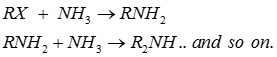
Q8. Halogenation of alkanes is a
Answer : Option A
Explaination / Solution:
Halogenation of alkanes is a substitution reaction because the hydrogen atoms are replaced by halogens in the presence of sunlight to give the corresponding alkyl halides.The reaction follows free radical mechanism.
Q9. Which of the following is a colligative property?
Answer : Option D
Explaination / Solution:
Colligative property is dependent on no. of moles of solute. (Л=cRT)
Q10. Initially HYVP was implemented in about
Answer : Option B
Explaination / Solution:
Initially HYVP was implemented in 2 million hectares. in 1997-98 the total area under HYVP was 76 million hectares, of which about 6 percent was under foodgrains.