General Science - Online Test
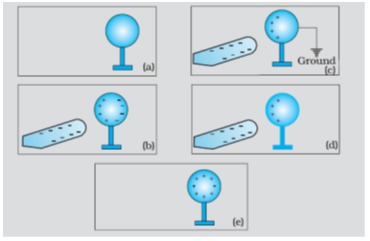
Q1. Which of the following methods can be used to charge a metal sphere positively without touching it . Select the best
Answer : Option C
Explaination / Solution:
This can be possible by induction, if a negative charge rod is placed near the sphere (at a distance not in touch) than it attracts positive charge inside the sphere towards its side and the negative charges collected on other side and when the surface of sphere connected to earth than the negative charge goes to earth and the sphere remain positively charged.
Q2. A perfectly rigid body is one
Answer : Option A
Explaination / Solution:
A perfectly rigid body is hypothetical in nature but for some phenomena ( in rotational bodies ) we assume bodies are perfectly rigid i.e. the intermolecular forces are always in equilibrium irrespective of the external forces due to which their shape and size are constant.
Q3. The techniques of using live organisms of enzymes from organism to produce products and processes useful to human is called
Answer : Option A
Explaination / Solution:
Biotechnology is the use of living systems and organisms to develop or make products, or "any technological application that uses biological systems, living organisms, or derivatives thereof, to make or modify products or processes for specific use".
Q4. Blood enters glomerular capillaries through _____ arteriole and leaves through _____ arteriole:
Answer : Option A
Explaination / Solution:
The blood plasma is filtered through the capillaries of the glomerulus into the capsule. The Bowman's capsule empties the filtrate into the proximal tubule that is also part of the duct system of the nephron. A glomerulus receives its blood supply from an afferent arteriole of the renal circulation
Q5. When the rate of evaporation is equal to the rate of condensation, it is called
Answer : Option D
Explaination / Solution:
At equilibrium, the rate of evaporation is equal to the rate of condensation.
It may be represented by H2O (l) ⇌ H2O (vap)
The double half arrows indicate that the processes in both the directions are going on simultaneously. The mixture of reactants and products in the equilibrium state is called an equilibrium mixture
Q6. Evolution is
Answer : Option C
Explaination / Solution:
Evolution is the gradual change of race due to variation is course of time. It is the history and development of race along with variations. Evolution is a continuous process and takes millions of years to evolve a new species.
Q7. Physical behavior of the states differs greatly even though chemical behavior of the three states is identical because
Answer : Option C
Explaination / Solution:
chemical properties depend on intramolecular bonding forces whereas physical properties depend on intermolecular nonbonding forces
Q8. The tissue present in all organs of plant is
Answer : Option D
Explaination / Solution:
Generally all the organs of plant are made up of parenchyma cells.
Q9. How many cells per hour does a single maize root apical meristem can give?
Answer : Option C
Explaination / Solution:
Growth is measured by a variety of parameters some of which are: increase in fresh weight, dry weight,length, area, volume and cell number.
one single maize root apical mersitem can give rise to more than17,500 new cells per hour, whereas cells in a watermelon may increase in size by upto 3,50,000 times.
In the former, growth is expressed as increase in cell number; the latter expresses growth as increase in size of the cell.
Q10. According to ‘plum pudding model’ atoms on the whole are electrically neutral because
Answer : Option C
Explaination / Solution:
No Explaination.