Mathematics - Online Test

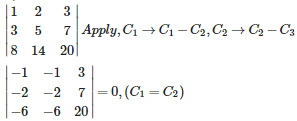
Q1.  is equal to
Answer : Option A
Explaination / Solution:


Q2. The coordinates of the foot of perpendicular from ( 0 , 0 ) upon the line x + y = 2 are
Answer : Option C
Explaination / Solution:

The equation of the line perpendicular to the given line is x - y + k = 0

Since it passes through the origin, 

0 - 0 + k = 0

Therefore k = 0

Hence the equation of the line is x - y = 0

On solving these two equations we get x = 1 and y = 1

The point of intersection of these two lines is (1,1)

Hence the coordinates of the foot of the perpendicular is (1,1)


Q3. The proposition (p→∼p)∧(∼p→p) is
Answer : Option D
Explaination / Solution:

   definition of 

Hence F


Q4. Which of the following is different from 
Answer : Option C
Explaination / Solution:


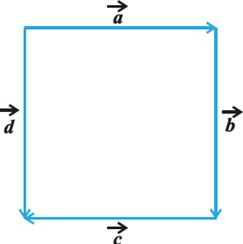
Q5. In the figure which are the collinear vectors?

Answer : Option B
Explaination / Solution:

 are collinear vectors , because are parallel in direction and same magnitude.
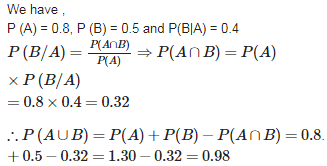
Q6. If P (A) = 0.8, P (B) = 0.5 and P(B|A) = 0.4, find P(A ∪ B)
Answer : Option A
Explaination / Solution:


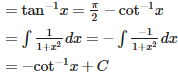
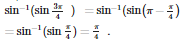
Q7. The principal value of 
Answer : Option A
Explaination / Solution:


Q8. In case of strict increasing functions, slope of the tangent and hence derivative is
Answer : Option D
Explaination / Solution:

If f is strictly increasing function , then f ‘ (x) can be 0 also . For example , f(x) = x3 is strictly increasing , but its derivative is 0 at x = 0. As another example , take f(x) = x + cosx ; here f ‘(x) = 1 – sinx , which is either +ve or 0 and the function x + cos x is strictly increasing.

Q9.

The centre of a circle passing through the points (0, 0), (1, 0) and touching the circle  is


Answer : Option A
Explaination / Solution:

Since the circle passes through (0,0) the equation reduces to 

c= 0 -----(1)

Since it passes through (1,0),

1 + 2g + c = 0

This implies g = -1/2

Since the circle touches the circle x2 + y2 = 9, their radii should be equal

2 = 3

Substituting the values and simplifying we get f = 

Hence the centre is (1/2, )


Q10.

Let  is a prime number . then :


Answer : Option C
Explaination / Solution:

Since when n = 41 we have , which is not a prime number.