Mathematics - Online Test
Q1. Numbers greater than 1000 but not greater than 5000 are to be formed with the digits 0, 1, 2, 3, 5, allowing repetitions, the number of possible numbers is
Answer : Option D
Explaination / Solution:
| th | h | t | o |
| 3 | 5 | 5 | 5 |
One's place can be occupied by any of the 5 numbers, tens place by any of the 5 numbers and hundreds place in 5 ways since repetition is allowed. But thousands place can be occupied by 2,3,1, only since the required number should be greater than 1000 and less than 5000.Hence total number of arrangement=3x5x5x5=375
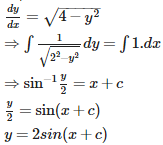
Q2. General solution of ( -2 < y < 2) is
Answer : Option B
Explaination / Solution:
Q3. A point ( x , y , z ) moves parallel to XY - plane . Which of the three variables x , y , z remain fixed ?
Answer : Option B
Explaination / Solution:
A point ( x , y , z ) moves parallel to XY - plane then x and y -coordinate will vary and z will fixed
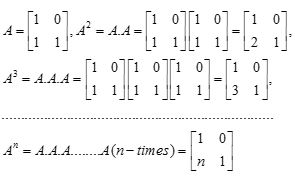
Q4. If, then for all natural numbers n, is equal to
Answer : Option D
Explaination / Solution:
Q5. If , then
Answer : Option A
Explaination / Solution:
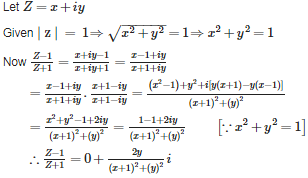
which is purely imaginary number.
Also when y=0, the number will become zero
Q6. The Collection of intelligent students in a class is
Answer : Option C
Explaination / Solution:
Intelligency Can not measured by numbers i.e the collection is not well defined thats why it can not be called as a Set
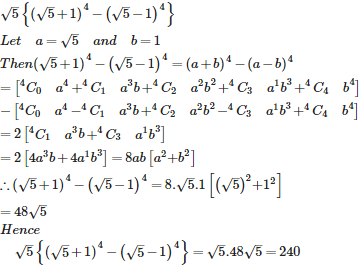
Q7. is
Answer : Option A
Explaination / Solution:
Q8. Let g (x) be continuous in a neighbourhood of ‘a’ and g (a) ≠ 0. Let f be a function such that f ‘ (x) = g(x) then
Answer : Option A
Explaination / Solution:
Since g is continuous at a , therefore , if g ( a ) > 0 , then there is a neighbourhood of a, say ( a-e , a+ e ) in which g ( x ) is positive .This means that f ‘ (x)>0 in this nhd of a and hence f ( x ) is increasing at a.
Q9. The area bounded by the curves = x andy = is
Answer : Option A
Explaination / Solution:
The two curves meet in ( 0 , 0 ) and ( 1, 1 ).The required area lies above the curve y = x2 and below x = y2 and is equal to ;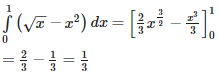
Q10. The solution for the simultaneous linear inequalities 2x − 3 ≤ 7 and − x ≤ 2 is :
Answer : Option C
Explaination / Solution:
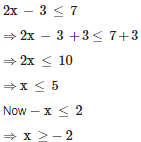
Therefore the solution of the simultaneous linear equalities is