Mathematics - Online Test

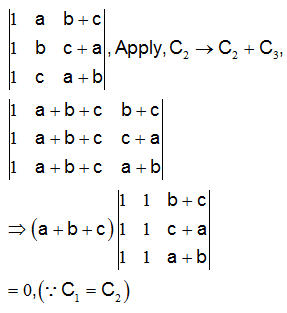
Q1. The value of the determinant 
Answer : Option B
Explaination / Solution:

since C1 And C2 are identical

=(a+b+c)x0 =0


Q2. The straight lines x + y - 4 = 0 , 3x + y – 4 = 0 , x - 3y – 4 = 0 form a triangle which is
Answer : Option A
Explaination / Solution:

The triangle formed by these lines is a right angled triangle

If the lines are perpendicular to each other, then the product of their slopes is -1

The slope of lines  3x + y – 4 = 0 , x - 3y – 4 = 0 are  -3 and 1/3 respectively.

The product of the slopes is -1

Hence these two lines are perpendicular to each other

This infers that the triangle formed by these lines is a right angled triangle.

Q3. Let p and q be two propositions. Then, the contrapositive of the implication p→q is
Answer : Option B
Explaination / Solution:

the contrapositve of p→q is∼q→∼p

Q4.  is equal to
Answer : Option B
Explaination / Solution:

ddx(f(x)dx)=f(x)
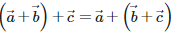
Q5. for vector addition which of the following is correct?
Answer : Option A
Explaination / Solution:

Addition of two vectors i.e. vector addition is associative. i.e. 
Q6. The conditional probability of an event E, given the occurrence of the event F lies between
Answer : Option C
Explaination / Solution:

As the probability of any event always lies between 0 and 1. Therefore , 0 ≤ P (E|F) ≤ 1.

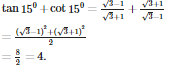
Q7. he value of is
Answer : Option B
Explaination / Solution:


Q8. The inequality  is true for :
Answer : Option B
Explaination / Solution:

When n = 1  we get , and when n = 2 we get ,. when n = 3 , which are inavlid inequations. Only when n = 4 we get , which is valid.

Q9. The function f (x) = [x] is
Answer : Option D
Explaination / Solution:

Case 1 Let c be a real number which is not equal to any integer. for all real numbers close to c the value of the function is equal to [c]; i.e., . Also and hence the function is continuous at all real numbers not equal to integers.

Case 2 Let c be an integer. Then we can find a sufficiently small real number  such that 

This, in terms of limits mean that 

Since these limits cannot be equal to each other for any c, the function is discontinuous at every integral point.


Q10. The number of points on X-axis which are at a distance c units (c 3) from ( 2, 3) is
Answer : Option B
Explaination / Solution:

the shortest distance from x-axis to the point is 3.