Mathematics - Online Test
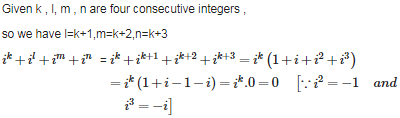
Q1. If k , l, m , n are four consecutive integers , then is equal to :
Answer : Option B
Explaination / Solution:
Q2. If A and B are two sets , then A∪(A∩B) is equal to
Answer : Option B
Explaination / Solution:
LetA={1,2,3,4}andB={1,2,3,4,5,6}HereA∩B={1,2,3,4}NowA∪(A∩B)={1,2,3,4,}=A
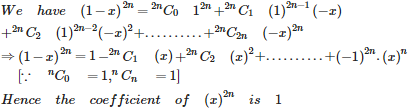
Q3. The coefficient of in the expansion of is
Answer : Option C
Explaination / Solution:
Q4. The area bounded by the curve y = 4x - and the x- axis is equal to
Answer : Option C
Explaination / Solution:
For x – axis , y = 0,
Therefore,
Therefore , x = 0 or x = 4.
Required area :
= = = 32 - - 0 =
Therefore,
Therefore , x = 0 or x = 4.
Required area :
= = = 32 - - 0 =
Q5. A solution is to be kept between and What is the range of temperature in degree Fahrenheit.What is the range of temperature in degree Fahrenheit if conversion formula is given by where C and F represent temperature in degree Celcius and degree Fahrenheit?
Answer : Option B
Explaination / Solution:
According to the question
Since , we get
Hence the range of temperature in degree Fahrenheit is between and
Q6. , where a > 0, is equal to
Answer : Option D
Explaination / Solution:
letx=1t;⇒Ltt→0at−1t=lna
Q7. If two corner points of the feasible region are both optimal solutions of the same type, i.e., both produce the same maximum or minimum.
Answer : Option D
Explaination / Solution:
If two corner points of the feasible region are both optimal solutions of the same type, i.e., both produce the same maximum or minimum , then any point on the line segment joining these two points is also an optimal solution of the same type .
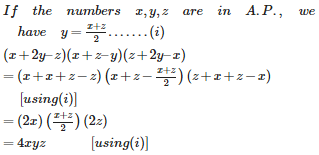
Q8. If x, y, z are in A.P., then (x + 2y – z) (x + z – y) (z + 2y – x) is equal to
Answer : Option B
Explaination / Solution:
Q9. The coefficient of correlation r satisfies
Answer : Option D
Explaination / Solution:
r can't be numerically more than 1
Q10. Let A = {1, 2, 3, 4, 5, 6}. Which of the following partitions of A correspond to an equivalence relation on A?
Answer : Option B
Explaination / Solution:
Conditions for the partition sub-sets to be an equivalence relation:
(i) The partition sub-sets must be disjoint i.e.their is no common elements between them
(ii) Their union must be equal to the main set (super-set)
Here the set A={1,2,3,4,5,6},the partition sub-sets {1,3},{2,4,5},{6} are pairwise disjoint and their union i.e. {1,3} U {2,4,5} U {6} = {1,2,3,4,5,6} = A,which is the condition for the partition sub-sets to be an equivalence relation of the set A.