Mathematics - Online Test
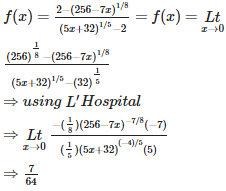
Q1. Let then for f to be continuous at x = 0, f (0) must be equal to
Answer : Option C
Explaination / Solution:
Q2. In Corner point method for solving a linear programming problem one finds the feasible region of the linear programming problem ,determines its corner points and evaluates the objective function Z = ax + by at each corner point. Let M and m respectively be the largest and smallest values at corner points. In case feasible region is unbounded, M is the maximum value of the objective function if
Answer : Option C
Explaination / Solution:
In Corner point method for solving a linear programming problem one finds the feasible region of the linear programming problem ,determines its corner points and evaluates the objective function Z = ax + by at each corner point. Let M and m respectively be the largest and smallest values at corner points. In case feasible region is unbounded, M is the maximum value of the objective function if the open half plane determined by ax + by > M has no point in common with the feasible region . Otherwise Z has no maximum value.
Q3. The number of numbers between n and which are divisible by n is
Answer : Option D
Explaination / Solution:
No Explaination.
Q4. The Mode of the following items is 0,1,6,7,2,3,7,6,6,2,6,0,5,6,0.
Answer : Option B
Explaination / Solution:
6 is the most frequent value here.
Q5. Let A = {a, b, c} then the range of the relation R = {(a, b), (a, c), (b, c)} defined on A is
Answer : Option B
Explaination / Solution:
Since the range is represented by the y- co ordinate of the ordered pair ( x , y ).Therefore, range of the given relation is { b , c }.
Q6. The line passing through ( 1, 1 ) and parallel to the line 2x – 3y + 5 = 0 is
Answer : Option D
Explaination / Solution:
The required line is parallel to the given line, hence it has same slope
Therefore the equation of the required line is 2x-3y+k=0
Since it passes through (1,1)
2(1) - 3(1) +k = 0
Therefore k=1
Hence the equation of the required line is 2x - 3y + 1=0
Q7. If the inverse of implication p→q is defined as ∼p→∼q , then the inverse of proposition (p∧∼q)→r is
Answer : Option C
Explaination / Solution:
as given the rule of inverse in question it becomes ∼(p∧∼q)→∼r
=(∼p∨q)→∼r
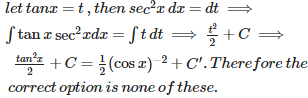
Q8. dx is not equal to
Answer : Option A
Explaination / Solution:
Q9. If is a real number is a
Answer : Option C
Explaination / Solution:
If a vector is multiplied by any scalar then , the result is always a vector.
Q10. Two events A and B will be independent, if
Answer : Option D
Explaination / Solution:
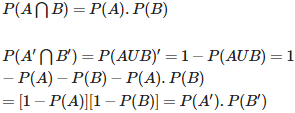
Two events A and B will be independent, then