Mathematics - Online Test
Q1. The determinant 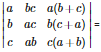
Answer : Option B
Explaination / Solution:
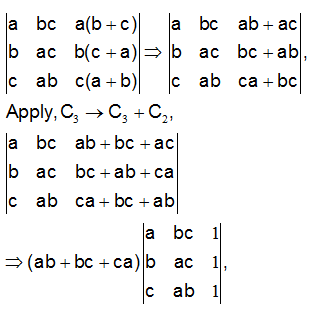
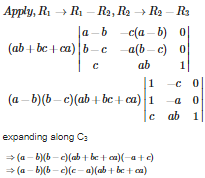
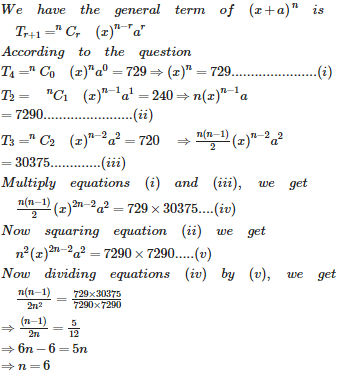
Q2. If the first three terms in the expansion of are 729, 7290 and 30375 respectively, then the value of n is
Answer : Option B
Explaination / Solution:
Q3. A man wants to cut three lengths from a single piece of board of length 91 cm. The second length is to be 3 cm longer than the shortest and third length is to be twice as long as the shortest. What are the possible lengths for the shortest board if the third piece is to be at least 5 cm longer than the second?
Answer : Option B
Explaination / Solution:
Let the length of the shortest piece be x cm.Then we have the length of the second and third pieces are x+3 and 2x centimeters respectively.
According to the question,
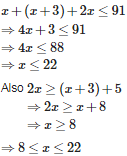
Hence the shortest piece may be atleast 8 cm long but it cannot be more than 22cm in length.
Q4. equal to
Answer : Option B
Explaination / Solution:
Now using L'Hospital we have,
Again using L'Hospital,
Again using L'hospital;
Q5. In Corner point method for solving a linear programming problem one finds the feasible region of the linear programming problem ,determines its corner points and evaluates the objective function Z = ax + by at each corner point. If M and m respectively be the largest and smallest values at corner points then
Answer : Option B
Explaination / Solution:
In Corner point method for solving a linear programming problem one finds the feasible region of the linear programming problem ,determines its corner points and evaluates the objective function Z = ax + by at each corner point. If Mand m respectively be the largest and smallest values at corner points then If the feasible region is bounded, M and m respectively are the maximum and minimum values of the objective function .
Q6. pth term of an H.P. is qr and qth term is pr, then rth term of the H.P. is
Answer : Option C
Explaination / Solution:
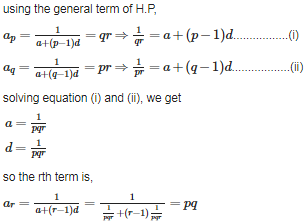
Q7. The H.M. of 4,8,16 is
Answer : Option B
Explaination / Solution:
H.M=31a+1b+1c=314+18+116=48/7=6.85
Q8. Let A = {1, 2, 3}, then the domain of the relation R = {(1, 1), (2, 3), (2, 1)} defined on A is
Answer : Option A
Explaination / Solution:
Since the domain is represented by the x- co ordinate of the ordered pair ( x , y ).Therefore, domain of the given relation is { 1 , 2 }.
Q9. If a line is drawn through the origin and parallel to the line x – 2y + 5 = 0 , its equation is
Answer : Option D
Explaination / Solution:
If the line is parallel to the given line x-2y + 5 =0,
then the required line will have same slope
Hence the equaion of the given line is x-2y+k=0
since it passes through the origin,
0+0+k=0
Therefore k=0
Hence the equation of the required line is x-2y=0 or x=2y
Q10. ∼(p∨q)∨(∼p∧q) is logically equivalent to
Answer : Option A
Explaination / Solution:
distributive law
since
since