Mathematics - Online Test

Q1. Determine order and degree (if defined) of 
Answer : Option B
Explaination / Solution:

Order = 2 , degree = 1 .Since the highest derivative term is  and its power is 1

Q2. The sum of all the numbers which can be formed by using the digits 1 , 3 , 5 , 7 ,9 all at a time and which have no digit repeated is
Answer : Option A
Explaination / Solution:

First we will fix any one digit in a fixed position .Then we have the remaining 4 digits can be arranged in 4! different ways.

Which means each of the five digits can appear in each of the five places in  4! times.

Hence the sum of the digits in each position is 

Now to find the sum  of these numbers formed we have to consider the place values  for these digits

So the sum of all the numbers which can be formed by using the digits 1 , 3 , 5 , 7 ,9=


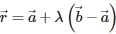
Q3. Vector equation of a line that passes through two points whose position vectors are  is
Answer : Option D
Explaination / Solution:

Vector equation of a line that passes through two points whose position vectors are  is given by:  

Q4.

is equal to


Answer : Option D
Explaination / Solution:


Q5. The area bounded by the curve  and the x –axis is
Answer : Option B
Explaination / Solution:

The given curve consists of two straight lines x + y = 1 ( x ≥ 0 )and -x + y = 1 ( x < 0 )
Required area :
 = == = 1sq.unit 

Q6.
The graph of the equation  in the three dimensional space is

Answer : Option B
Explaination / Solution:
No Explaination.


Q7. If is a square root of the  identity matrix, then a, b, c satisfy the relation
Answer : Option B
Explaination / Solution:

acbaacba=1001a2+bc=1
Q8.

At (0, 0) the curve 


Answer : Option D
Explaination / Solution:

 and hence the tangent to the curve at ( 0 , 0 ) makes an angle of  with +ve X-axis.

Q9. Distance of the representative of the number 1 +i from the origin ( in Argand’s diagram ) is
Answer : Option B
Explaination / Solution:

Let P(x,y) represent the complex number  Z=x+iy  in the complex plane(Argand plane) and let O(0,0) be the origin

Then we have OP=

Here Z=1+i so that P(x,y)=P(1,1)

Hence OP=


Q10. Which of the following is a null set ?
Answer : Option B
Explaination / Solution:


[i=imaginory root of unity which is a complex no.]

since the solution of x doesnot belongs to real no hence the set is null set