Mathematics - Online Test
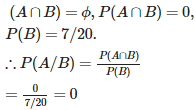
Q1. Consider the experiment of throwing a die, if a multiple of 3 comes up, throw the die again and if any other number comes, toss a coin. Find the conditional probability of the event ‘the coin shows a tail’, given that ‘at least one die shows a 3’.
Answer : Option C
Explaination / Solution:
S = {(3,1), (3,2), (3,3), (3,4), (3,5), (3,6), (6,1), (6,2), (6,3), (6,4), (6,5), (6,6), (1,H), (2,H), (4,H), (5,H), (1,T), (2,T), (4,T), (5,T)} Let A = event that coin shows a tail. i.e. A = { (1,T), (2,T), (4,T), (5,T)} and B = event that atleast one die shows 3. B = {(3,1), (3,2), (3,3), (3,4), (3,5), (3,6),(6,3)}
Q2. cos2θ is not equal to
Answer : Option B
Explaination / Solution:
is equals to 
Q3. is equal to
Answer : Option D
Explaination / Solution:
Q4. The greatest positive integer , which divides n ( n + 1 ) ( n + 2 ) ( n + 3 ) for all n ∈N , is
Answer : Option C
Explaination / Solution:
If n = 1 then the statement becomes 1x2x3x4= 24 : the consecutive natural numbers when substituted will be multiples of 24.
Q5. If (x-a)2 + (y-b)2 = c2 represents a circle, then
Answer : Option D
Explaination / Solution:
(x-a)2 + (y-b)2 = c2 here (a,b) is center and c is the radius
and radius cannot be zero because if radius is zero it will become a point or degenerate circle so c0.
Q6. The number of arrangements of n different things taken r at a time which exclude a particular thing is
Answer : Option C
Explaination / Solution:
The number of arrangements of n different things taken r at a time which exclude a particular thing is n-1Pr = P(n-1,r)
Q7. Find the order and degree of is
Answer : Option A
Explaination / Solution:
Order = 3 ,Since the highest order derivative is but degree cannot be defined ,because the deriative term y’ is present in exponential form.
Q8. Angle between skew lines is
Answer : Option A
Explaination / Solution:
Angle between skew lines is the angle between two intersecting lines drawn from any point parallel to each of the skew lines .
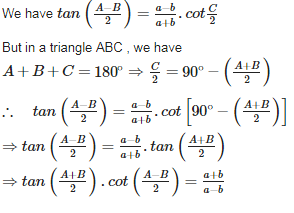
Q9. In a triangle ABC, is equal to
Answer : Option C
Explaination / Solution:
Q10. The area bounded by the curve y = , the x – axis and two ordinates x = 1 and x = 2 is
Answer : Option B
Explaination / Solution:
sq.units.