Electronic Science - Online Test
Q1. Consider a combination of T and D flip-flops connected as shown below. The output of the D flip-flops is connected to the input of the T flip-flop and the output of the T Flip-flop connected to the input of the D Flip-flop. 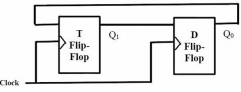
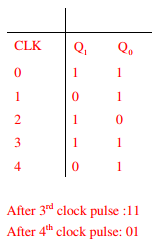
Initially, both Q0 and Q1 are set to 1 ( before the 1st clock cycle). The outputs
Answer : Option B
Explaination / Solution:
Q2. A small impurity is added to germanium to get p-type semiconductor. This impurity is a
Answer : Option C
Explaination / Solution:
In a pure (intrinsic) Si or Ge semiconductor, each nucleus uses its four valence electrons to form four covalent bonds with its neighbors. Each ionic core, consisting of the nucleus and non-valent electrons, has a net charge of +4, and is surrounded by 4 valence electrons. Since there are no excess electrons or holes In this case, the number of electrons and holes present at any given time will always be equal.
Now, if one of the atoms in the semiconductor lattice is replaced by an element with three valence electrons, such as a Group 3 element like Boron (B) or Gallium (Ga), the electron-hole balance will be changed. This impurity will only be able to contribute three valence electrons to the lattice, therefore leaving one excess hole. Since holes will "accept" free electrons, a Group 3 impurity is also called an acceptor.
Q3. 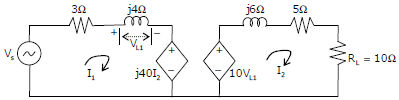
In the circuit shown below, if the source voltage Vs = 100∠53.13° V then the Thevenin’s equivalent
voltage in Volts as seen by the load resistance RL is
Answer : Option C
Explaination / Solution:
No Explaination.
Q4. The dielectric constant K of an insulator can be
Answer : Option D
Explaination / Solution:
Dielectric constant of air is 1. All dielectrics generally have a value of the dielectric constant greater than 1.where is the force between two charged particles in a medium of dielectric constant K and F is the force between the two charges when placed in air.The force between two charges is greatest in air or vacuum and it decreases when any medium is placed between the charges. K cannot have negative, fractional or zero values.
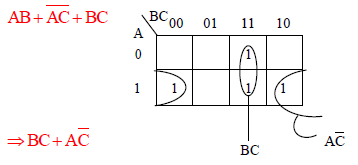
Q5. The Boolean expression  simplifies to
simplifies to
Answer : Option A
Explaination / Solution:
Q6. The magnetic induction in air at point 1 cm away from a long wire that carries a current of 1 A, will be
Answer : Option D
Explaination / Solution:
B=μ0I2πr=4π×10−7×12π×1×10−2=2×10⁻⁵T
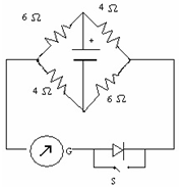
Q7. In the circuit shown below, the galvanometer G will show zero deflection
Answer : Option C
Explaination / Solution:
The ratio of the resistances in the arms is not equal. The wheatstone’s network is not balanced. The galvanometer will continue to show deflection in all cases.
Q8. The full form of the abbreviations TTL and CMOS in reference to logic families are
Answer : Option C
Explaination / Solution:
TTL -> Transistor - Transistor logic
CMOS -> Complementary Metal Oxide Semi-conductor
Q9. If you made a map of magnetic field lines at Melbourne in Australia, would the or of the ground?
Answer : Option C
Explaination / Solution:
No Explaination.
Q10. 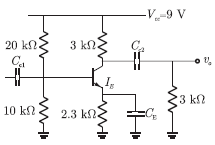
In the following transistor circuit,  , and 𝛽 and all the capacitances are very large
, and 𝛽 and all the capacitances are very largeThe mid-band voltage gain of the amplifier is approximately
Answer : Option D
Explaination / Solution:
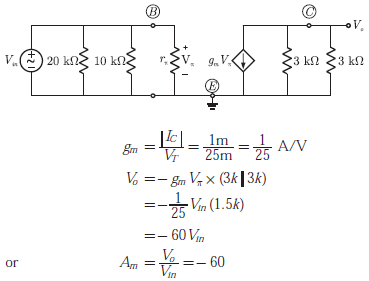
The small signal model is shown in fig below