Electronic Science - Online Test
Q1. When the conductivity of a semiconductor is only due to breaking of the covalent bonds, the semiconductor is called
Answer : Option B
Explaination / Solution:
A pure semiconductor is called intrinsic semiconductor, e.g., silicon, germanium. The presence of the mobile charge carriers is the intrinsic property of the material. At room temperature, some covalent bonds are broken and electrons are made free. The absence of electron in the covalent bond form hole.
The electrical conduction is by means of mobile electrons and holes. Hole act as positive charge, because it can attract an electron. If some other bond is broken and the electron thus freed fills this hole(vacancy), it seems as though the hole is moving.
Actually an electron is travelling in opposite direction. In a pure(intrinsic) semiconductor, the number of holes is equal to the number of free electrons.
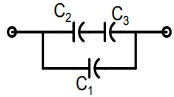
Q2. Three capacitors C1, C2, and C3, whose values are 10µF, 5µF, and 2µF respectively, have
breakdown voltages of 10V, 5V, and 2V respectively. For the interconnection shown, the maximum
safe voltage in Volts that can be applied across the combination and the corresponding total charge
in µC stored in the effective capacitance across the terminals are respectively
Answer : Option C
Explaination / Solution:
No Explaination.
Q3. For a parallel plate capacitor and a dielectric of dielectric constant K When a dielectric material is inserted between the plates while_______________ the potential difference between the plates decreases by a factor K
Answer : Option B
Explaination / Solution:
When a dielectric material is introduced in between the plates of a charged capacitor, which is disconnected from the battery, the charge remains constant, while the potential decreases by a factor K. The charge on the plates will increase if the dielectric material is slipped in between the plates of a capacitor which remain connected to the battery. In this case, the potential across the plates of the capacitor remains constant being equal to thebattery voltage.
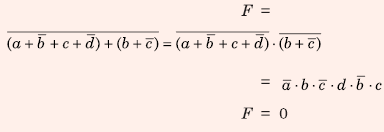
Q4. The Boolean expression  simplifies to
simplifies to
Answer : Option D
Explaination / Solution:
Q5. 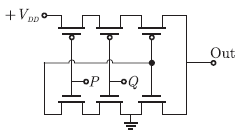
The logic function implemented by the following circuit at the terminal OUT is
Answer : Option D
Explaination / Solution:
From the figure shown below it may be easily seen upper MOSFET are shorted
and connected to Vdd thus OUT is 1 only when the node S is 0,
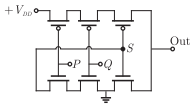
Since the lower MOSFETs are shorted to ground, node S is 0 only when input P
and Q are 1. This is the function of AND gate.
Q6. A Current carrying wire produces in its neighbourhood
Answer : Option D
Explaination / Solution:
Static charges produce only an electric field. Moving charges produce a magnetic field in addition to their electric fields.
Q7. An electric bulb rated for 500 watts at 100 volts is used in a circuit having 200 volt supply. The resistance R that must be put in series with the bulb so that the bulb draws 500 watts is
Answer : Option C
Explaination / Solution:
The resistance of the bulb RB = V2/P = 1002/500 = 20\Omega 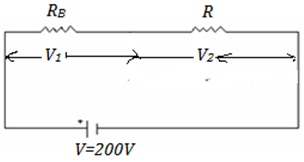
When connected across a 200V supply with a resistor R in series, the power drawn remains the same. If V1 be the p.d across the bulb,V12 = P {RB} = 500 * 20 = 104;
V1 = 100V, . Therefore the p.d across R =200-100=100 V. Therefore R=RB=20Ω
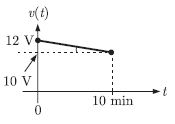
Q8. A fully charged mobile phone with a 12 V battery is good for a 10 minute talktime. Assume that, during the talk-time the battery delivers a constant current of 2 A and its voltage drops linearly from 12 V to 10 V as shown in the figure. How much energy does the battery deliver during this talk-time?
Answer : Option C
Explaination / Solution:
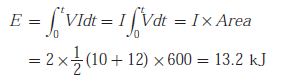
The energy delivered in 10 minutes is
Q9.
The angle of dip at a location in southern India is about . Dip angle in Britain would be
Answer : Option C
Explaination / Solution:
No Explaination.
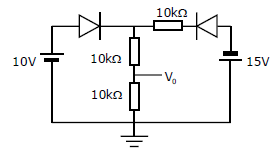
Q10. Assuming that the diodes in the given circuit are ideal, the voltage V0 is
Answer : Option B
Explaination / Solution:
No Explaination.