Mathematics - Online Test
Q1. Which one of the following average is most affected of extreme observations ?
Answer : Option D
Explaination / Solution:
As A/M is calculated as the sum of all the observations divided by number of observations, so it is affected by if there is any change in the outliers
Q2. If A is a finite set containing n distinct elements, then the number of relations on A is equal to
Answer : Option D
Explaination / Solution:
The number of elements in A x A is n x n = n2. hence ,the number of relations on A = number of subsets of A x A = 2nxn =.
Q3. The equation of the line which passes through the point ( 1 , - 2 ) and cuts off equal intercepts from the axis is
Answer : Option B
Explaination / Solution:
Let the equation of the line which has equal intercepts be
+ =1
Substituting the values for x and y
1 -2 =a
Therefore a = -1
Hence the equation of the line is x+y+1=0
Q4. The logically equivalent propositions of p↔q is
Answer : Option C
Explaination / Solution:
p↔q≡(p→q)∧(q→p)
Q5. The value of the integral dx lies in
Answer : Option B
Explaination / Solution:
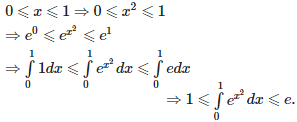
Q6. Vectors A and B are equal
Answer : Option B
Explaination / Solution:
Two vectors having same magnitude as well as same direction are always equal.
Q7.
Let ( be a partition of a sample space and suppose that each of has nonzero probability. Let A be any event associated with S,then
Answer : Option A
Explaination / Solution:
Let {E1, E2, ...,En) be a partition of a sample space and suppose that each of E1, E2, ..., En has nonzero probability. Let A be any event associated with S,then P(A) = P(E1) P (A|E1) + P (E2) P (A|E2) + ... + P (En) P(A|En) .by addition law of probability.
Q8. If is equal to
Answer : Option A
Explaination / Solution:
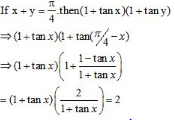
Q9. is divisible by 64 for all
Answer : Option A
Explaination / Solution:
when n = 1 the value is 64. By induction process the consecutive replacement of n = 2,3,4....will be multiples of 64.
Q10.
is equal to
Answer : Option B
Explaination / Solution:
limx→0tanxlog(1+x)=limx→0tanxxxlog(1+x)=limx→0tanxx.limx→011xlog(1+x)=1.11=1