Mathematics - Online Test
Q1. In a bank, principal increases continuously at the rate of r% per year. Find the value of r if Rs 100 double itself in 10 years (loge2 = 0.6931).
Answer : Option B
Explaination / Solution:
Let P be the principal at any time t. then,
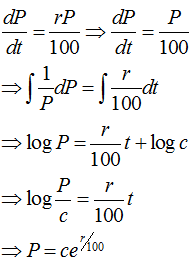
When P = 100 and t = 0., then, c = 100, therefore, we have:
Now, let t = T, when P = 100., then;
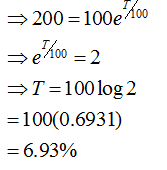
When P = 100 and t = 0., then, c = 100, therefore, we have:
Now, let t = T, when P = 100., then;
Q2. Amp. then locus of z is
Answer : Option B
Explaination / Solution:
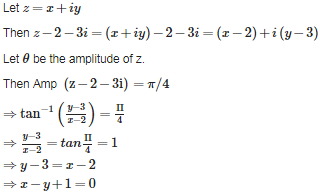
Q3. Find a if the coefficient of x2 and x3 in the expansion of are equal
Answer : Option C
Explaination / Solution:
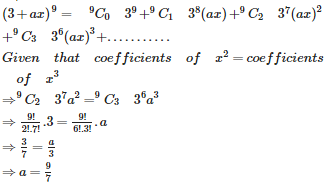
Q4. The smallest set A such that A ∪{ 1,2 } = { 1,2,3,5,9 } is
Answer : Option B
Explaination / Solution:
The union of two sets A and B is the set of elements in A, or B, or both.
so smallest set A={3,5,9}
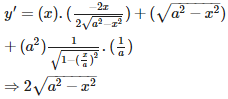
Q5. is equal to
Answer : Option B
Explaination / Solution:
Q6. One kind of cake requires 200g of flour and 25g of fat, and another kind of cake requires 100g of flour and 50g of fat. Find the maximum number of cakes which can be made from 5kg of flour and 1 kg of fat assuming that there is no shortage of the other ingredients used in making the cakes.
Answer : Option C
Explaination / Solution:
Let number of cakes of first type = x
And number of cakes of second type = y
Therefore , the above L.P.P. is given as :
Minimise , Z = x +y , subject to the constraints : 200x +100y ≤ 5000 and. 25x +50y ≤ 1000, i.e. 2x + y ≤ 50 and x +2y ≤ 40 x, y ≥ 0.
The corner points can be obtained by constructing the lines x+2y=40 , 2x+y= 50 and x+2y = 40.
The points so obtained are (0,0),(25,0), (20,10), and (0,20).
Corner points | Z = x + y |
O( 0 , 0 ) | 0 |
D(25,0 ) | 25 |
A(20,10) | 30……………..(Max.) |
B(0,20) | 20 |
Here Z = 30 is maximum.
i.e Maximum number of cakes = 30 , 20 of kind one and 10 cakes of another kind .
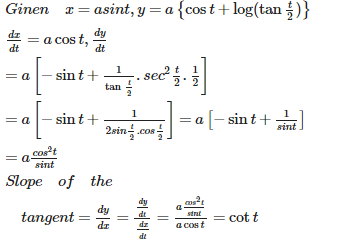
Q7. The slope of the tangent to the curve x = a sin t, y = a at the point ‘t’ is
Answer : Option D
Explaination / Solution:
Q8. Solve the system of inequalities : ,
Answer : Option A
Explaination / Solution:
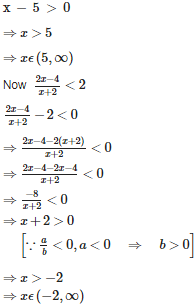
Hence the solution set is
which means
Q9. The next term of the sequence 1, 3, 6, 10, …. Is
Answer : Option A
Explaination / Solution:
In this sequence the nth term is,
so, for n = 5,
Q10. If COV(X,Y) = 0 , then the two lines of the regression are
Answer : Option D
Explaination / Solution:
Using the formulae,
here
therefore