Biology - Online Test
Q1. Cup-like structure formed by adnation of sepals, petals and stamens is
Answer : Option D
Explaination / Solution:
In angiosperms a hypanthium is a structure where basal portions of the calayx, the corolla and the stamens form a cup-shaped tube.
Q2. During zygotene stage chromosomes start pairing together and the process is called as
Answer : Option B
Explaination / Solution:
During zygotene stage, the homologous chromosomes start pairing together and this process of association is called synapsis. The paired homologous chromosomes are called bivalents.
Q3. The smallest bands in the agarose gel will be towards
Answer : Option D
Explaination / Solution:
Gel electrophoresis technique involves separation of different segments of DNA according to their size. The smallest bands in the agarose gel will be towards positively charged anode.
Q4. Vasopressin is a hormone involved in regulation of urine formation. It is secreted from :
Answer : Option B
Explaination / Solution:
An excessive loss of fluid from the body can activate receptors which stimulate the hypothalamus to release antidiuretic hormone (ADH) or vasopressin from the neurohypophysis.
Q5. Evolution and natural selection is demonstrated by
Answer : Option C
Explaination / Solution:
Evolution and natural selection can be demonstrated by DDT resistance in Mosquito. Earlier, mosquitoes are not resistance to DDT. They get killed due to presence of DDT but later on more DDT is used and due to natural selection mosquito become resistant to DDT.
Q6. In leaves, the ground tissue consists of thin-walled chloroplast containing cells are called
Answer : Option C
Explaination / Solution:
The tissues of a leaf that are located in between the layers of epidermis and carry on photosynthesis, consisting of the palisade layer and the spongy parenchyma. Most mesophyll cells contain chloroplasts.
Q7. The number of categories in hierarchical classification is
Answer : Option B
Explaination / Solution:
Taxonomical studies of all known organisms have led to the development of common categories such as kingdom, phylum (for animals) or division (for plants), class, order, family, genus and species. Hence, the correct option is 7.
Q8. Which one prevents premature fall of fruit?
Answer : Option A
Explaination / Solution:
They help to prevent fruit and leaf drop at early stages but promote the abscission of older mature leaves and fruits.
Q9.
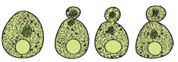
Identify the organism and type of reproduction in figure below
Answer : Option B
Explaination / Solution:
Asexual mode of reproduction in yeast takes place by budding process in which small outgrowth develops on tips followed by karyokinesis. Same process is repeated several times to form chain of yeast cells.
Q10. Forests controls drought through
Answer : Option B
Explaination / Solution:
The volume of water retained by forests can depend on characteristics such as forest cover area, the length of vegetation growing season, tree composition and tree density, as well as the age and the number of layers of vegetation cover. Water retention by forests affects the amount and timing of the water delivered to streams and groundwater by increasing and maintaining infiltration and storage capacity of the soil. Forests can soak up excess rainwater, preventing run-offs and damage from flooding. By releasing water in the dry season, forests can also help provide clean water and mitigate the effects of droughts. Drought is due to less rainfall.