Biology - Online Test
Q1. Which group of three elements is required for both photosynthesis mitochondrial electrons transport?
Answer : Option B
Explaination / Solution:
Three elements, Cu, Mn and Fe is required for both photosynthesis as well as mitochondrial electron transport for ATP formation.
Q2. One of the gut hormones which is often referred to as the "hunger hormone" since it works as a strong stimulant for appetite and feeding is :
Answer : Option C
Explaination / Solution:
Ghrelin the hunger hormone is a peptide hormone produced by ghrelinergic cells in the gastrointestinal tract which function as neurpeptide in the central nervous system. It stimulates appetite and feeding.
Q3. Carcinoma refers to
Answer : Option A
Explaination / Solution:
Carcinoma is a type of cancer or Malignant tumors of the skin or mucous membrane that starts in cells that make up the skin or the tissue lining organs, such as the liver or kidneys.
The physical, chemical or biological agents that convert normal cell into cancerous cell are called carcinogens.
Q4. Select the correct terms for labels
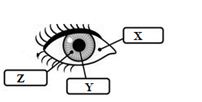
Answer : Option A
Explaination / Solution:
The external layer is composed of a dense connective tissue and is called the sclera. The ciliary body itself continues forward to form a pigmented and opaque structure called the iris which is the visible coloured portion of the eye. In front of the lens, the aperture surrounded by the iris is called the pupil.
Q5. The root like structure which help in anchorage and absorption of water in Bryophytes is called
Answer : Option A
Explaination / Solution:
Rhizoids are the root like structures present in Bryophytes that help in anchorage and absorption of water. They are thin hair like structure generally present at ventral surface of Bryophytes.
Q6. The chromosome having centromeres at one terminal end is called
Answer : Option A
Explaination / Solution:
A telocentric chromosome's centromere is located at the terminal end of the chromosome. Telomeres may extend from both ends of the chromosome.their shape is like i during anaphase. For example, the standard house mouse karyotype has only telocentric chromosomes.
Humans do not possess telocentric chromosomes
Q7. Number of nitrogenous bases in a Codon is
Answer : Option B
Explaination / Solution:
A codon is a sequence of 3 nitrogenous bases located on mRNA that will pair up with the anticodon of tRNA to make the polypeptide (protein) I. 64 codons can be obtained from four nitrogenous bases if arranged in group of 3.
Q8. Light harvesting complexes are made up of
Answer : Option D
Explaination / Solution:
Light harvesting complexes (LHC) within the Photosystem I (PS I) and Photosystem II (PS II). These are named in the sequence of their discovery, and not in the sequence in which they function during the light reaction. The LHC are made up of hundreds of pigment molecules.
Q9.
RBCs and muscle cells carry out anaerobic respiration, but :
i. RBCs are permanently anaerobic and muscle cells are temporarily anaerobic
ii. RBCs are temporarily anaerobic and muscle cells are permanently anaerobic
iii. Muscle cells lack mitochondria.
Answer : Option D
Explaination / Solution:
Red blood cells and muscle cells carry out anaerobic respiration but RBC’s are permanently anaerobic and muscle cells are temporarily anaerobic in nature.
Q10. The capacity to generate a whole plant from any cell/ explant is called
Answer : Option B
Explaination / Solution:
The ability to generate a whole plant from any cell/explant is called totipotency. Tissue culture method is used to generate whole plant from plant parts.