Biology - Online Test
Q1.
Read the following statements:
i. Based on emission, there are point and diffusion sources of water pollution.
ii. Fertilisers are example of point sources of water pollution.
iii. Industrial discharge pipes are examples of diffusion sources of water pollution.
Answer : Option B
Explaination / Solution:
On the basis of emission of pollutants in water bodies, there are point and diffusion sources of water pollution. Fertilizers are example of diffusion sources of water and industrial discharge pipes are example of point source of water pollution.
Q2. Select the insectivorous plant from the following.
Answer : Option B
Explaination / Solution:
Those plants that eats insect to fulfill its protein requirement are called insectivorous plants. They have modified leaves to capture insects. Drosera is an insectivoresous plant.
Q3. Each chromosome consists of ---- chromatid.
Answer : Option A
Explaination / Solution:
The resulting two identical copies of DNA are connected to each other at the centromere. Each copy is called a chromatid. A chromosome, before cell division is formed of one chromatid while it is formed of two chromatids after cell division.
Q4. The extraction of DNA from the agrose gel is called as
Answer : Option C
Explaination / Solution:
The extraction of specific bands of DNA from agarose gels in which they are separated through electrophoresis is known as elution. There are many methods for eluting DNA from a piece of agrose.
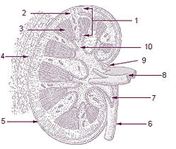
Q5. In the following diagram what are 7,9 & 10 :
Answer : Option D
Explaination / Solution:
Towards the centre of the innerconcave surface of the kidney is a notchcalled hilum through which ureter, bloodvessels and nerves enter. Inner to the hilumis a broad funnel shaped space called therenal pelvis with projections called calyces. The medulla is divided into a few conical masses projecting into the calyces. Thus, 7, 9, and 10 are pelvis, hilum and calyx respectively.
Q6. According to early Greek thinker unit of life called
Answer : Option D
Explaination / Solution:
According to early Greek thinker units of life called spores. These spores were transferred to different planets including earth.
Q7. Tracheids differ from vessels in having
Answer : Option D
Explaination / Solution:
Tracheids and vessels are main water and mineral conducting tissues of xylem. Tracheid have pointed tips but vessels have blunt ends.
Q8. The point at which exponential phase ends and decelerating phase begins is called
Answer : Option D
Explaination / Solution:
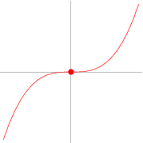
An inflection point is a point on a curve at which the sign of the curvature (i.e., the concavity) changes. Inflection points may be stationary points, but are not local maxima or local minima.
For example, for the curve plotted given, the red point is an inflection point.
Q9. Which are the terms interchangeable?
Answer : Option A
Explaination / Solution:
Thecharacterisation, identification, classification and nomenclature are the processes that are basic to taxonomy as well as systematics. Hence, the correct option is Taxonomy and systematics.
Q10. Flagellated, motile asexual reproductive structure are called
Answer : Option A
Explaination / Solution:
A number of simple organism produce single or multi-flagellated spores called zoospores. Water is essential for this mode of reproduction. Aplanospores are non-flagellated spores.