Biology - Online Test
Q1.
Match the following :
| Hormone | Target tissue/cell |
| a) Follicle stimulating hormone | i) liver |
| b) Luteinising hormone | ii) kidney tubule |
| c) Cortisol | iii)sertoli cells |
| d) Aldosterone | iv) interstitial cells |
Answer : Option B
Explaination / Solution:
Follicle stimulating hormone acts on sertoli cells. Luteinsing hormone acts on interstitial cells. Cortisol cells acts on liver and Aldosterone hormone acts on kidney tubule.
Q2. Choose the correct sequence:
Answer : Option A
Explaination / Solution:
A number of species living in a particular area makes the population. Different population of a ecosystem forms community and communities in a geographical area are called biome.
Q3. The most common mineral elements which became deficient in agricultural soil are
Answer : Option B
Explaination / Solution:
The minerals elements like nitrogen, phosphorus and potassium are required by plants in larger quantity. These elements becomes deficient in agricultural soil.
Q4. The dental formula for human deciduous and permanent set are :
212/212 and 2123/2123
So the deciduous set lacks :
Answer : Option B
Explaination / Solution:
Arrangement of teeth in each half of the upper and lower jaw in the order I, C, P, M,
is represented by a dental formula which in human is 2123/2123. 212/212 lacks premolar.
Q5. Antigen binding site in an antibody is found between
Answer : Option B
Explaination / Solution:
The antigen-binding (Fab) fragment is a region on an antibody that binds to antigens. It is composed of one constant and one variable domain of each of the heavy and the light chain.
Q6. The band of nerve fibers that joins the two cerebral hemisphere in mammals is :
Answer : Option D
Explaination / Solution:
The corpus callosum (CC) is the largest of the commissural fibres, linking the cerebral cortex of the left and right cerebral hemisphere.
Q7. Pond scum is
Answer : Option D
Explaination / Solution:
Green patchy structure that develops around the surface of stagnant water bodies having thread like mass are called pond scum. They are actually a species of green algae ],Spirogyra.
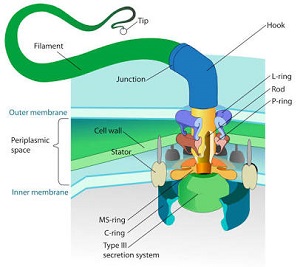
Q8. The bacterial flagellum consists of
Answer : Option D
Explaination / Solution:
A bacterial flagellum has 3 basic parts: a filament, a hook, and a basal body.
1) The filament is the rigid, helical structure that extends from the cell surface.
2) The hook is a flexible coupling between the filament and the basal body.
3) The basal body consists of a rod and a series of rings that anchor the flagellum to the cell wall and the cytoplasmic membrane.
Q9. A phenomenon where the third base of t-RNA at its 5’ end can pair with a non-complementary base of m-RNA is called
Answer : Option D
Explaination / Solution:
In 1966, Francis Crick proposed the Wobble Hypothesis. He postulated that the 5' base on the anticodon, which binds to the 3' base on the mRNA, was not as spatially confined as the other two bases, and could, thus, have non-standard base pairing.
Crick creatively named it for the small amount of play that occurs at this third codon position. Movement ("wobble") of the base in the 5' anticodon position is necessary for small conformational adjustments that affect the overall pairing geometry of anticodons of tRNA.
Q10. Which of the following pyramid/s is/are inverted:
Answer : Option D
Explaination / Solution:
In the aquatic system, the biomass can increase at higher trophic levels. For example, in Oceans, the food chain typically starts with phytoplankton and ends at predatory fish, which has largest biomass. Thus, the pyramid of biomass is inverted in the aquatic systems including marine, ponds etc.