Biology - Online Test
Q1. When blood clot starts contracting, a pale yellow fluid starts oozing out. Its name and composition is :
Answer : Option D
Explaination / Solution:
Plasma without the clotting factors is called serum. The clotting factors include fibrinogen and blood corpuscles.
Q2. Which of the following is an example of co-dominance?
Answer : Option A
Explaination / Solution:
Co-dominance is the phenomenon that deviates from Mendel’s law of inheritance. Both the alleles appear in offspring instead of one as in Mendel’s experiment. ABO blood grouping in human being is example of co-dominance in which both IA and IB appear simultaneously to form AB blood type.
Q3. The partial breakdown of glucose takes place in
Answer : Option B
Explaination / Solution:
Fermentation is an anaerobic breakdown of carbohydrates in which an organic molecule is the final electron acceptor. It does not involve an electron transport system.
Furthermore,: it is a partial breakdown of glucose giving a little energy, 2 net ATP's per glucose by way of substrate-level phosphorylation.
Q4. The amount of oxygen that would be consumed if all the organic matter in one liter of water were oxidized by bacteria is called
Answer : Option D
Explaination / Solution:
Biological Oxygen Demand is the amount of oxygen that would be consumed if all the organic matter in one liter of water are oxidized by bacteria. it is used as indicator of water pollution. More the value of BOD higher the water polluted.
Q5. That species which is found in highest concentration within a polluted water reservoir is called :
Answer : Option A
Explaination / Solution:
A number of organisms grow in polluted water. The species whose concentration is highest in polluted water is celled as index species as this species indicate the presence of particular kinds of pollutant in water.
Q6. Parthenogenesis is the development of unfertilized ovum into a fully formed haploid organism. Natural parthenogenesis is found in
Answer : Option C
Explaination / Solution:
Development of individual from unfertilized ovum is called parthenogenesis. The individual is haploid as no fusion of gametes occurs. Honey bee is of three kinds namely queen, drone and worker. Workers are produced parthenogenetically.
Q7. The correct arrangement of the zones as seen in the vertical section of root is
(i) Root hair zone
(ii) Zone of meristem
(iii) Root cap zone
(iv) Zone of maturation
(v) Zone of elongation
Answer : Option A
Explaination / Solution:
The correct arrangement of the zones as seen in the vertical section of root is root cap zone, region of meristematic activity, region of elongation, region of maturation and root hair region.
Q8. The stage of inactivation of cell cycle due to non-availability of mitogens and energy rich compounds is called
Answer : Option B
Explaination / Solution:
It is the stage of cell cycle during which the cells remain metabolically active and do not divide due to absence of mitogens and energy producing compounds.
Q9. Restriction enzymes belongs to a larger class of enzymes called
Answer : Option B
Explaination / Solution:
A restriction enzyme (or restriction endonucleases) recognizes a specific base pair sequence in DNA called a restriction site and cleaves the DNA (hydrolyses the phosphodiester backbones) within the sequence. Restriction enzymes are widely found in prokaryotes and provide protection to the host cell by destroying foreign DNA that makes entry to it. It acts as a part of defense mechanism.
Restriction enzymes belong to a larger class of enzymes called nucleases. They are of two types: endonucleases and exonucleases.
Q10. Label the following in diagram
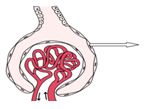
Answer : Option B
Explaination / Solution:
The diagram shown above is Malpighian body or renal corpuscles. The marked part in this is called Podocytes or visceral epithelial cells in Bowman’s capsule in the kidney that warp around capillaries of the glomerules.