Biology - Online Test
Q1. Interacting members of species live close to each other in following interaction/s:
Answer : Option A
Explaination / Solution:
Individual organisms live together in an ecosystem and depend on one another. In fact, they have many different types of interactions with each other, and many of these interactions are critical for their survival.
Interacting members of species live close to each other in commensalism, predation and parasitism.
Q2. Element that is necessary for controlling metabolic activities is
Answer : Option A
Explaination / Solution:
Calcium activates certain enzymes and plays an important role in regulating metabolic activities.
Q3. The bile duct and the pancreatic duct open together into the duodenum as
Answer : Option A
Explaination / Solution:
The bile duct and the pancreatic duct open together into the duodenum as the common hepato-pancreatic duct which is guarded by a sphincter called the sphincter of Oddi.
[Add mage here]
Q4. Post erythrocytic part of life cycle of plasmodium is called
Answer : Option D
Explaination / Solution:
The post erythrocytic part of life cycle of plasmodium is called Ross cycle. This cycle is named after the scientist Ronald Ross, who discovered the cycle of malarial causing protozoa, plasmodium.
Q5.
In the following figure a synapse is shown :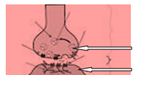
i & ii (from up to down)
1) (i) is presynaptic membrane and (ii) is postsynaptic membrane.
2) synaptic vesicles are in postsynaptic knob.
3) neurotransmitter receptors are located on postsynaptic membrane.
Answer : Option C
Explaination / Solution:
The synapse is formed by the membranes of apre-synaptic neuron and a post-synaptic neuron, which may or may notbe separated by a gap called synaptic cleft. The neurotransmitter receptors are located on postsynaptic membrane.
Q6. Which classes of algae possess chlorophyll a, chlorophyll b, carotenoids and xanthophylls?
Answer : Option B
Explaination / Solution:
Phaeophyceae possess chlorophyll a, c, carotenoids and xanthophylls. They vary in colour from olive green to various shades of brown depending upon the amount of the xanthophyll pigment, fucoxanthin present in them.
Q7. Each centriole is surrounded by dense amorphous protoplasmic masses called
Answer : Option B
Explaination / Solution:
All animal cell have two small organelles called centrioles. Each centriole is surrounded by dense amorphous protoplasmic masses called Massules.
Q8. Which of the following is structural subunit of DNA?
Answer : Option A
Explaination / Solution:
Consisting of a five-carbon sugar (deoxyribose) a phosphate group and a nitrogenous base, a nucleotide links with another nucleotides in a repeating sequence, forming a very long, continuous strand of DNA.
The nitrogenous base will be one of four types: Guanine(G), Adenine (A), Cytosine (C) or Thymine (T).
Q9. Organism/s living as both producer as well as consumer is/are
Answer : Option A
Explaination / Solution:
Nepenthes (pitcher plant) and Drocera are insectivores plants to compensate their protein requirement. They have green leaves that perform photosynthesis process. So, they act as both producer as well as consumer.
Q10. The splitting of water molecule take place inside
Answer : Option D
Explaination / Solution:
Splitting of the water molecule takes place on the inner side of the membrane, the protons or hydrogen ions that are produced by the splitting of water accumulate within the lumen of the thylakoids.