Biology - Online Test
Q1. Which is not a vestigial organ of man?
Answer : Option D
Explaination / Solution:
Vestigial organs are those organs which were functional in our ancestor but become functionless in present form of human beings.
Nail is not a vestigial organ of man as our fingernails are proportionately the same size as our wild counterparts, they are Not reduced structures. They still maintain their original function so they are Not atrophied or functionless.
Q2.
Statement I: In zygote intra fallopian transfer(ZIFT) embryo upto 8 blastomeres are transferred into fallopian tube.
Statement II: In intra uterine transfer, embryo more than 8 blastomeres are transferred to uterus.
Answer : Option A
Explaination / Solution:
In test tube baby programme, sperms and ovum are fertilized in laboratory condition to form zygote. If embryo is transferred up to 8 blastomeres, it is called ZIFT. If embryo having more than 8 blastomeres, it is transferred to uterus called IUT.
Q3. DNA probes used in finger printing are
Answer : Option A
Explaination / Solution:
In finger printing the nylon membrane was incubated with radioactive probes. DNA Probes are small fragments of minisatellite DNA tagged with radioactive phosphorous. The probes only attach to the pieces of DNA that they are complementary to – in this case they attach to the minisatellites in the genome. Radioactive isotopes can be easily identified using scanner.
Q4.
Identify the part of Blastocyst labelled as “A”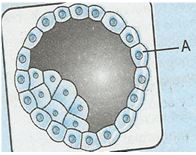
Answer : Option D
Explaination / Solution:
Merula divides mitotically and transforms into blastocyct. The blastomeres in the blastocyst are arranged into an outer layer called trophoblast.
Q5. Correct order is
Answer : Option C
Explaination / Solution:
The correct order of geological periods is Paleozoic, Mesozoic and Coenozoic. Each period have characteristic plants and animals evolved over the period of time.
Q6. Gamete intra fallopian transfer (GIFT) is useful for
a. Female that does not produce eggs or ovum but can provide suitable environment for fertilisation and further development.
b. Female that have blocked fallopian tube that carry ovum and fertilized egg to uterus.
a. Female that does not produce eggs or ovum but can provide suitable environment for fertilisation and further development.
b. Female that have blocked fallopian tube that carry ovum and fertilized egg to uterus.
Answer : Option B
Explaination / Solution:
Some infertile females are not able to produce ovum or egg but can provide suitable medium for fertilisation and further development of embryo. In such females gamete intra fallopian transfer technique is used to conceive.
Q7. The technique of DNA fingerprinting has many applications ranging from identifying paternity to finding criminals. The sensitivity of the technique has been increased by use of
Answer : Option C
Explaination / Solution:
Polymerase chain reaction (PCR) is a technique used in molecular biology to amplify a single copy or a few copies of a segment of DNA across several orders of magnitude, generating thousands to millions of copies of a particular DNA sequence.
This increae the sensitivity of the technique.
Q8. Which germinal layer forms blood, heart, blood vessels etc.?
Answer : Option B
Explaination / Solution:
Human beings are triploblastic. The outer layer is called ectoderm that forms central nervous system and nerves etc. The middle layer or mesoderm forms heart, blood and blood vessels. The inner layer forms liver, pancreas etc.
Q9. Which of the following is an example of environmental variation?
Answer : Option A
Explaination / Solution:
Environmental variation is the change in traits due to environmental factors like temperature, humidity, soil water precipitation etc. Dying hair colour blue or any other colour is environmental variation.
Q10. DNA fingerprinting involves identifying differences in some specific regions of DNA sequence called repetitive DNA because
Answer : Option A
Explaination / Solution:
In specific regions of DNA sequence, a small stretch of DNA is repeated many times. The repetitive DNA are separated from bulk genomic DNA during density gradient centrifugation.