Biology - Online Test
Q1. The gases which are transparent to solar radiation but retain long wave heat radiations are called
Answer : Option A
Explaination / Solution:
A greenhouse gas (often abbreviated as GHG) is a gas that both absorbs and emits radiation in the infrared range, commonly called thermal radiation or heat. When present in the atmosphere, these gases trap radiation in the form of heat, causing a warming process called the greenhouse effect.
These gases are transparent to solar radiation.
Q2. Acetyl CoA combine with oxalo-acetate in presence of condensing enzyme citrate synthetase to form 6-C compound called
Answer : Option C
Explaination / Solution:
Acetyl CoA combine with oxalo-acetate in presence of enzyme citrate synthetase to form 6-C compound called citric acid during Kreb’s cycle.
Q3. M- phase undergoes
Answer : Option C
Explaination / Solution:
Since, in mitosis the number of chromosomes in the parent and progeny cells is the same, it is also called as equational division.
Q4. Nucleosome is seen in
Answer : Option D
Explaination / Solution:
The nucleosome is the fundamental subunit of chromatin. Nucleosome is clearly seen in fungus called Yeast.
Q5. Praying mantis is a good example of
Answer : Option A
Explaination / Solution:
The Praying Mantis is a large insect from the order of Mantodea. It's called the "Praying" Mantis because it often stands in a pose that looks like it is praying.
Many animals have evolved to exhibit some form of camouflage, which is an adaptation that allows animals to blend in with certain aspects of their environment
Praying Mantids use camouflage to hide from predators and sneak up on prey. Different species vary in color from dark brown to green. These colors allow them to blend into their natural surroundings such as tree bark or green plant leaves.
Q6. Classification based on evolutionary and genetic relationship is called
Answer : Option A
Explaination / Solution:
The classification of organisms on the basis of evolutionary and genetic relationship is called phylogenetic system of classification. The organisms are arranged according to their evolution on earth.
Q7. In arborescent monocots stem, a secondary cambium grows in
Answer : Option B
Explaination / Solution:
In arborescent monocots stem, secondary cambium grows in hypodermal region for secondary growth that increase the girth of the stem.
Q8. What would be expected to happen if a rotten fruit gets mixed with unripe fruits
Answer : Option A
Explaination / Solution:
Rotten fruit produce ethylene gas that hasten the ripening of unripe fruits. So, if a rotten fruit get mixed with unripe fruits the remaining unripe get ripen faster.
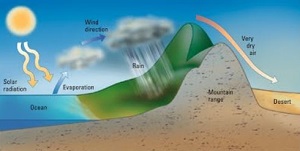
Q9. In a rain shadow area biome is represented by
Answer : Option A
Explaination / Solution:
A rain shadow is a dry area on the leeward side of a mountainous area (away from the wind). The mountains block the passage of rain-producing weather systems and cast a "shadow" of dryness behind them. Wind and moist air is drawn by the prevailing winds towards the top of the mountains, where it condenses and precipitates before it crosses the top. The air, without much moisture left, advances behind the mountains creating a drier side called the "rain shadow".
Q10. When the stamens in a flower remain free, it is said to be
Answer : Option A
Explaination / Solution:
The stamens in a flower may either remain free (polyandrous) or may be united in varying degrees.