Biology - Online Test
Q1.
What should be TDS of and in soft water?
Answer : Option D
Explaination / Solution:
TDS stands for total dissolved solids which are inorganic salts dissolved in water. The TDS of soft water should be up to 120 ppm.
Q2. Crossing over brings
Answer : Option C
Explaination / Solution:
Crossing over brings recombination or new combination of genes and hence variations. It occurs during cell division in prophase stage of meiosis-I.
Q3. Cyanobacteria serves as important biofertilizers in the fields of
Answer : Option C
Explaination / Solution:
Rice field contain water all the time. In this water Cyanobacteria grows easily that have ability to fix atmospheric nitrogen into nitrates and nitrites that increase the fertility.
Q4. The left atrium receives deoxygenated blood in :
Answer : Option A
Explaination / Solution:
Deoxygenated blood from body parts reaches to left atrium of lizards but in human beings left atrium receives the oxygenated blood.
Q5. The cytochrome c moves in between
Answer : Option D
Explaination / Solution:
Cytochrome c is a small protein attached to the outer surface of the inner membrane and acts as a mobile carrier for transfer of electrons between complex III and IV.
Q6. A gas produced by paddy fields and involved in global warming is
Answer : Option D
Explaination / Solution:
Anaerobic decomposition of plants in water produces methane gas in paddy field. This gas is involved in global warming as methane is a green house gas beside carbon dioxide.
Q7. Bat is member of order
Answer : Option B
Explaination / Solution:
Bat is a member of order Chiroptera of class Mammalia. Bats are only mammals to have achieved powered fight in which forelimb is modified as wings.
Q8. At the end of meiosis II how many cells are formed?
Answer : Option B
Explaination / Solution:
Four haploid cells are formed at the end of meiosis II. It is reductional division resulting in halving of chromosome number in daughter cells.
Q9. Electroporation helps in the introduction of foreign DNA into target organism by
Answer : Option D
Explaination / Solution:
Electroporation, or electropermeabilization, is a microbiology technique in which an electrical field is applied to cells in order to increase the permeability of the cell membrane, allowing chemicals, drugs, or DNA to be introduced into the cell.
In microbiology, the process of electroporation is often used to transform bacteria, yeast, or plant protoplasts by introducing new coding DNA.
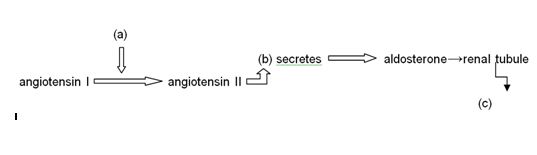
Q10. What are the unlabeled a, b & c in the given flow chart ?
Answer : Option D
Explaination / Solution:
Renin convert angiotensin I to angiotensin II which activates adrenal cortex to release aldosterone. Aldosterone helps to reabsorption of sodium and water from DCT.