Biology - Online Test
Q1. In a population, unrestricted reproductive capacity is called as
Answer : Option A
Explaination / Solution:
Unrestricted reproductive capacity of a population is called biotic potential. Having coitus with opposite partners may leads to pregnancy and cause a number of problems to individual as well as society.
Q2. Nasal septum contains
Answer : Option A
Explaination / Solution:
The nasal septum of human beings consist of hyaline cartilage which is highly elastic having collagen. It contains no nerves or blood vessels and is pearly bluish in colour.
Q3. A water melon has water percentage about
Answer : Option C
Explaination / Solution:
Each bite of watermelon contains about 92 percent water and 6 percent sugar. Since it consists mostly of water, its name makes perfect sense! Despite being mostly water with a bit of sugar, watermelon is considered a very healthy snack. Its high water content helps keep you hydrated.
Q4. Diatoms do not decay easily because
Answer : Option D
Explaination / Solution:
The walls of the diatoms are embedded with silica and thus the walls are indestructible.
Q5. Double fertilisation is fusion of
Answer : Option D
Explaination / Solution:
Double fertilisation is the fusion of Syngamy and triple fission. One male gamete fertilizes the egg and other male gamete fuse with two polar nuclei called triple fission.
Q6. Phytophagous insects will be categorized as
Answer : Option B
Explaination / Solution:
The insect that feeds on plant sap and other parts of plants are called phytophagous. Phytophagous insects will be similar to predators and plants acts as prey.
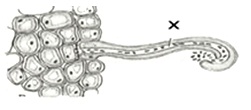
Q7. Identify the part of nodule marked X
Answer : Option B
Explaination / Solution:
The figure shown above is the nodule formation in leguminous roots. The part marked as ‘x’ shown is figure is infection thread through which Rhizobium enters the root.
Q8. Which of the following is not secreted from its source in the form of a Zymogen :
Answer : Option D
Explaination / Solution:
Zymogen is an inactive enzyme precursor that require biochemical change to become active. Amylase enzyme is not released from its source in the form of proenzyme or zymogen.
Q9. Choose the wrong statement regarding AIDS
Answer : Option D
Explaination / Solution:
AIDS is caused by human immune virus (HIV). HIV infects and kills B-lymphocytes. In this disease viral RNA genome is converted into DNA copy by reverse transcriptase.
Q10. Human internal ear is :
Answer : Option A
Explaination / Solution:
Human body is triploblastic in nature, ectoderm, mesoderm and endoderm. These three layers of embryo forms the different organs of human beings. Human internal ear is ectodermal in origin.