Mathematics - Online Test
Q1. 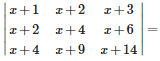
Answer : Option D
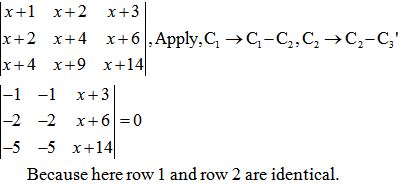
Explaination / Solution:
Q2.
Let f (x) – log(1 + x), where x > 0, then f is
Answer : Option C
Explaination / Solution:
Hence decreasing function.
Q3. The perpendicular distance of the origin from the line 3x +4y + 1 = 0 is
Answer : Option B
Explaination / Solution:
The perpendicular distance from the origin to the line is given by
For the given line c = 1, A = 3 and B = 4 and since it passes through the origin,
Sustituting the values we get,
= 1/5
Q4. ∼(p∧q) is logically equivalent to
Answer : Option B
Explaination / Solution:
∼(p∧q)≡∼p∨∼q De Morgan's law
Q5. If dx = g (x) + C and also dx = h(x) + D, then
Answer : Option A
Explaination / Solution:
Since g(x) and h(x) are integrals of the same function , therefore ; g(x) – h(x) is constant. 'OR'
[g(x)+C] - [f(x)+D]=0 => g(x) - f(x) = D-C, Which is a constant of integeration.
Q6. If are any three vectors then the correct expression for distributivity of scalar product over addition is
Answer : Option D
Explaination / Solution:
If are any three vectors then the correct expression for distributivity of scalar product over addition is: 
Q7. If E and F are events then P (E ∩ F) =
Answer : Option C
Explaination / Solution:
If E and F are events then P (E ∩ F) = P (E) P (F|E), P (E) ≠ 0. By the defination of conditional probability of two events
Q8. The value of is
Answer : Option B
Explaination / Solution:
The value of =
Q9. For each n N , is divisible by :
Answer : Option C
Explaination / Solution:
When n = 1 we have 391 which is divisible by 17.
Q10. 
Answer : Option D
Explaination / Solution:
Does not exist.