Mathematics - Online Test
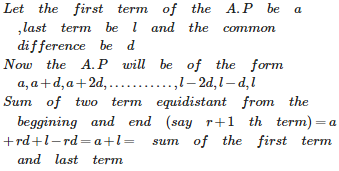
Q1. The sum of terms equidistant from the beginning and end in A.P. is equal to
Answer : Option D
Explaination / Solution:
Q2. The most stable measure of central tendency is
Answer : Option C
Explaination / Solution:
because takes into account every value in the given set of data to provide the average
Q3.
Let and x, y R} be a relation in R. The relation R is
Answer : Option B
Explaination / Solution:
A relation R on a non empty set A is said to be symmetric if fx RyyRx, for all x , y R Clearly is same as for all x , y R. Therefore ,R is symmetric.
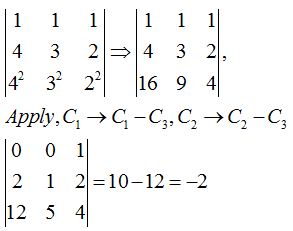
Q4. 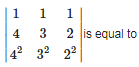
Answer : Option C
Explaination / Solution:
Q5. Let f (x) = then f (x) is
Answer : Option C
Explaination / Solution:
Hence an increasing function.
Q6.
The line which passes through the point ( 0 , 1 ) and perpendicular to the line x – 2y + 11 = 0 is
Answer : Option A
Explaination / Solution:
The line which is perpendicular to the given line is 2x + y + k = 0
Since it passes through (0,1)
2(0) + 1 + k = 0
This implies k = -1
Hence the equation of the required line is 2x + y - 1 = 0
Q7. ∼p∨∼q is logically equivalent to
Answer : Option B
Explaination / Solution:
The answer is rule of negation for ∼(p→∼q)≡∼p∨∼q
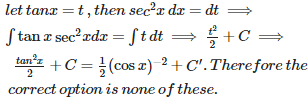
Q8. dx is not equal to
Answer : Option C
Explaination / Solution:
Q9. If and are any two points, then the vector joining P1 and P2 is the vector P1P2. Magnitude of the vector is
Answer : Option A
Explaination / Solution:
If and are any two points, then the vector joining P1 and P2 is the vector P1P2. then: = 
Q10. If E, F and G are events with P(G) ≠ 0 then P ((E ∪ F)|G) given by
Answer : Option C
Explaination / Solution:
P(EUF/G) ==
= +-
= P (E|G) + P (F|G) – P ((E ∩ F)|G)